The short answer: A brewery can prepare for a product recall by connecting every raw-material lot, yeast generation, production batch, packaging run, finished-goods code, and shipment in one traceable record. It should also maintain a written recall plan and test that plan with regular mock recalls. Beer30®, the brewery management software developed by The 5th Ingredient®, gives breweries grain-to-glass traceability in a single system.
Brewery traceability is the ability to track every ingredient and packaging component that goes into making a specific batch of beer, and then track your finished goods from that batch to its destination. Effective beer traceability works in both directions: backward from a finished product to its raw materials and forward from a raw-material lot to every affected package and customer.
For a brewery, complete traceability should answer four questions:
Product recall may be the two-word phrase no brewer wants to hear, but hoping it never happens is not a strategy.
A recall can begin with a supplier notice, a microbiological or chemical contaminant, an undeclared allergen, a packaging failure, a labeling error, or a product deviation discovered after beer has left the brewery. In the modern era, the challenge is compounded by increasingly complex routes to market. The same batch may be split among a taproom, multiple distributors, a satellite location, a contract partner, and direct-to-consumer orders. Breweries are also producing more package formats and, in many cases, products such as non-alcohol beer that require additional food-safety controls.
That makes traceability more than simply an exercise in compliance or sales tracking. It is an operational safeguard that helps a brewery protect consumers, preserve customer trust, reduce unnecessary product loss, and engage an appropriate response. In short…. it’s a critical part of protecting your business and your customers alike
The good news is that a brewery with connected, lot-specific records can drastically reduce the time, cost, and uncertainty of a recall. Because recalls always cost money, but a targeted one costs you far, far less. And that makes the following five steps crucial for any brewery.
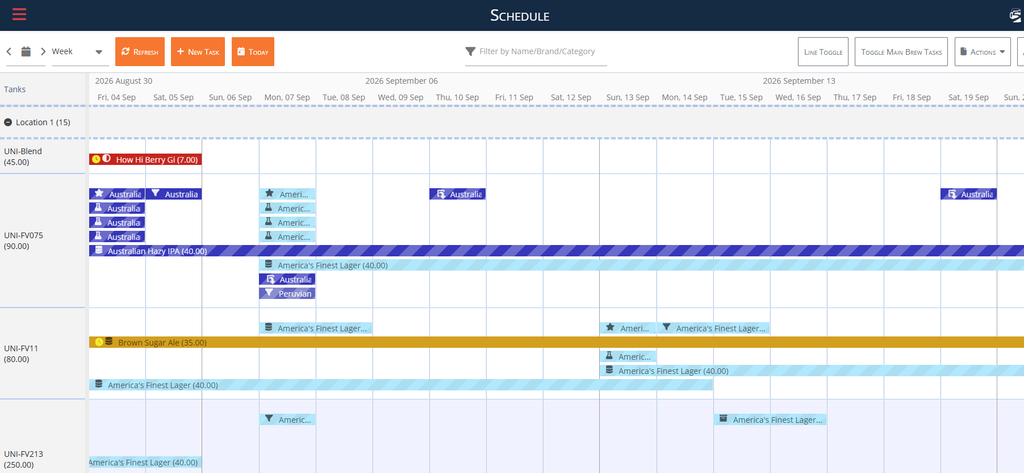
Recall readiness begins before the first ingredient is added to the mash. Your production plan should connect the beer you intend to make with the people, equipment, materials, and packaging required to make it.
At a minimum, track:
This distinction between planned and actual matters. Breweries regularly adapt when a COA isn’t what they expected, a variety is unavailable or too expensive, a tank stays occupied longer than expected, or a packaging run changes format. Those adjustments are not inherently a problem. Unrecorded adjustments, on the other hand, are.
Brewery management software such as Beer30 can connect the production schedule directly to execution records, so the final batch history reflects what truly happened, not merely what the recipe or original plan said should happen. If you still rely on paper or spreadsheets, establish a controlled process for recording changes in real time and reconciling missing information before the end of each shift. Paper logs have a tendency to get up and walk off, so the less time between action and data entry, the better.
Product recall may be the two-word phrase no brewer wants to hear, but hoping it never happens is not a strategy.
A recall can begin with a supplier notice, a microbiological or chemical contaminant, an undeclared allergen, a packaging failure, a labeling error, or a product deviation discovered after beer has left the brewery. In the modern era, the challenge is compounded by increasingly complex routes to market. The same batch may be split among a taproom, multiple distributors, a satellite location, a contract partner, and direct-to-consumer orders. Breweries are also producing more package formats and, in many cases, products such as non-alcohol beer that require additional food-safety controls.
That makes traceability more than simply an exercise in compliance or sales tracking. It is an operational safeguard that helps a brewery protect consumers, preserve customer trust, reduce unnecessary product loss, and engage an appropriate response. In short…. it’s a critical part of protecting your business and your customers alike
The good news is that a brewery with connected, lot-specific records can drastically reduce the time, cost, and uncertainty of a recall. Because recalls always cost money, but a targeted one costs you far, far less. And that makes the following five steps crucial for any brewery.
Recall readiness begins before the first ingredient is added to the mash. Your production plan should connect the beer you intend to make with the people, equipment, materials, and packaging required to make it.
At a minimum, track:
This distinction between planned and actual matters. Breweries regularly adapt when a COA isn’t what they expected, a variety is unavailable or too expensive, a tank stays occupied longer than expected, or a packaging run changes format. Those adjustments are not inherently a problem. Unrecorded adjustments, on the other hand, are.
Brewery management software such as Beer30 can connect the production schedule directly to execution records, so the final batch history reflects what truly happened, not merely what the recipe or original plan said should happen. If you still rely on paper or spreadsheets, establish a controlled process for recording changes in real time and reconciling missing information before the end of each shift. Paper logs have a tendency to get up and walk off, so the less time between action and data entry, the better.
If a maltster, hop supplier, fruit provider, or other vendor contacts you about an affected lot, you should be able to determine within minutes whether it entered your brewery, whether it was used, and which batches it was used in.
For every received material, record:
This applies not only to malt and hops, but also to fruit, purees, adjuncts, processing aids, cleaning chemicals, gases, water-treatment materials, and any ingredient that introduces an allergen or other declared labeling requirement.
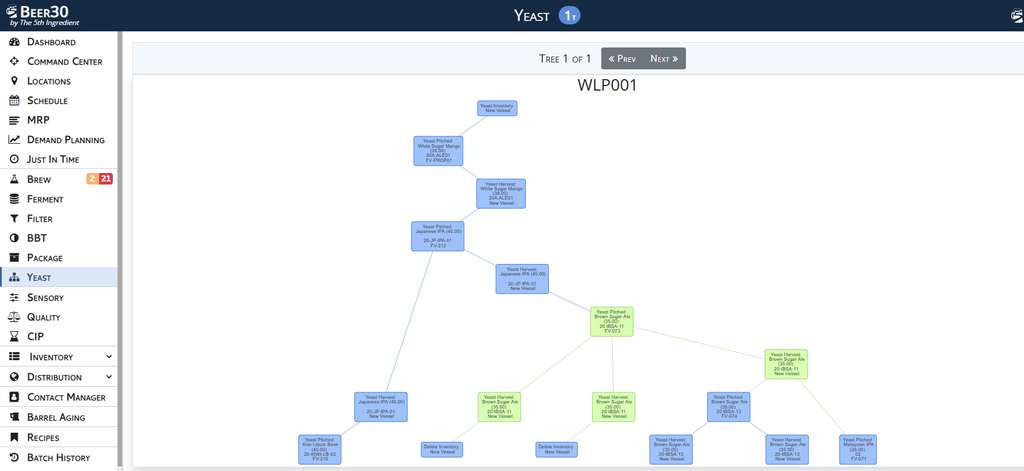
Yeast deserves its own connected record. A yeast genealogy should show where a culture originated and each batch into which it was pitched, harvested, repitched, blended, or propagated. If a fermentation problem or contamination event is linked to one generation, you need to see both the batch that produced it and every downstream batch that received it.
Beer30 records lot usage and yeast genealogy as part of the production history, creating a searchable relationship between incoming materials and finished beer. That way, you’re never having to guess what was used where, and your information and costing are as accurate as possible, every single time.
In 2026, many breweries sell through more channels than their recordkeeping systems were originally designed to handle. A complete distribution record should include product sent to:
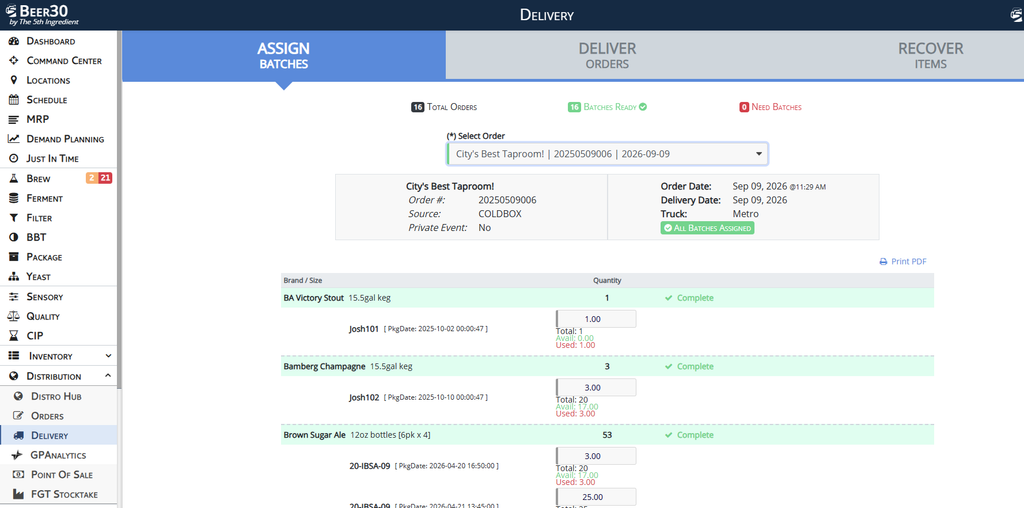
Record the customer or location, delivery date, SKU, quantity, and finished-goods batch for every product that crosses your dock and leaves your brewery for the market. And transfers between brewery-owned locations matter just as much as third-party sales, so moving beer to a second taproom does not end the traceability chain. Anyone who has ever had to check the code dates on several hundred cans can attest to that.
Your distributors also need to be part of the plan. Confirm what lot-level data they receive, what they retain, who their recall contact is, and how quickly they can return depletion, inventory, and account-level information. A brewery that can trace product only to a distributor warehouse still has a major visibility gap.
Beer30's Finished Goods Traceability (FGT) tools allow warehouse teams to assign specific batch numbers to orders as product is picked or loaded. That connects each shipped beer back through the packaging run, production batch, yeast lineage, and raw-material lots. One long chain of custody, so that you never miss out on the data you need to keep your business (and customers) protected.
Software can find the records, but people still have to make decisions. Your written recall plan should always include:
Run a mock recall at least annually, to ensure you’re never caught flat-footed when one does occur. Select a real ingredient lot or finished-goods batch and trace both directions:
Set a time limit and reconcile quantities. The exercise should account for what was produced, shipped, sold, sampled, lost, returned, destroyed, and still on hand. It should also reveal whether the necessary staff can access records when the person who normally runs the report is unavailable. And if this sounds like a lot, just remember that modern software tools make this process far, far quicker and easier than it once was. Most breweries, even those with only a handful of employees, can execute a recall without issue if they have the software support they need.
Paper logs can work, but only if they are complete, legible, organized, and immediately accessible. In a real recall, “we know the information exists somewhere” is just not good enough.
Digital traceability should provide:
The FDA's Food Traceability Rule introduced a broader framework based on Critical Tracking Events, Key Data Elements, traceability lot codes, and rapidly accessible electronic records for foods on its Food Traceability List. And while most beer is not itself on the Food Traceability List, breweries should determine whether any covered foods they manufacture, process, pack, or hold bring particular operations within scope. Either way, the framework is a useful model: capture the right information at the moment a product is received, transformed, or shipped, and keep it in a form that can be retrieved quickly.
Kegs deserve added attention. Knowing how many kegs are in the market, what they held, where they were shipped to, and how long they’ve been on-site helps immensely when tracing down any issues related to your keg fleet.
When a possible safety, quality, or labeling issue emerges, move quickly, but don’t just guess.
The TTB may request a final report covering the affected product and volume, communications, effectiveness, adverse-health information, corrective action, destruction, and possible tax implications. Good traceability records make that report faster to assemble and easier to defend.
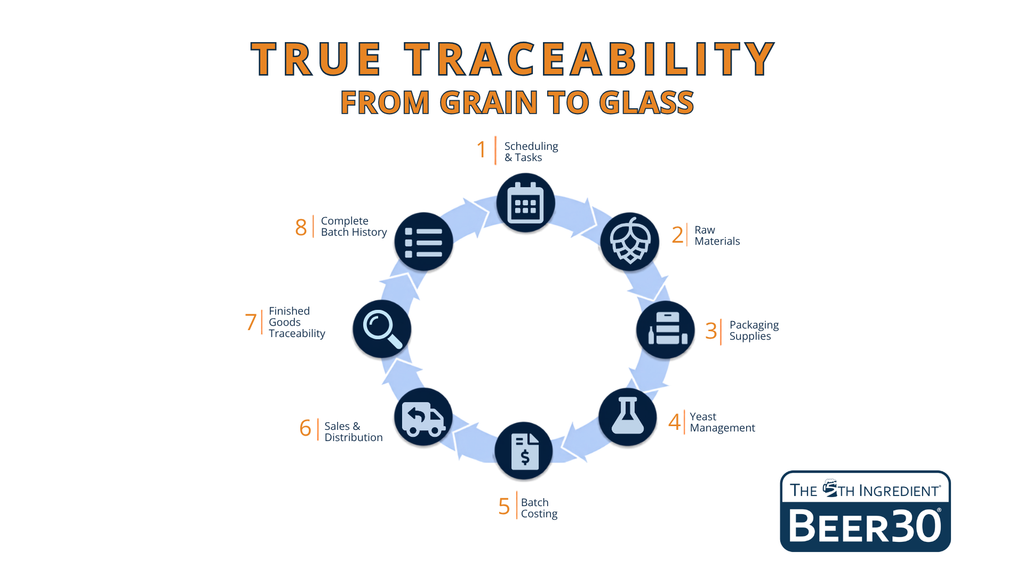
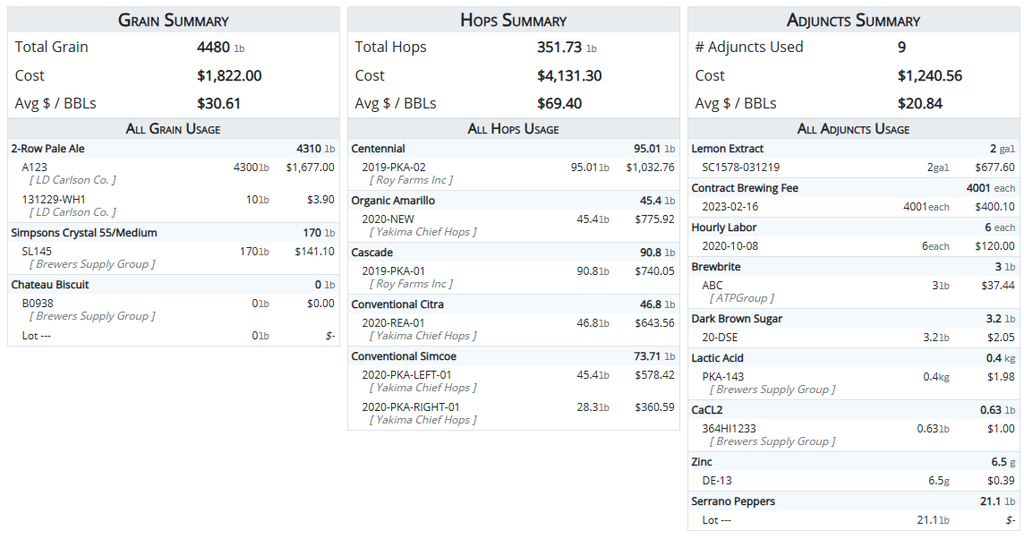
Beer30 is brewery management software created by The 5th Ingredient to connect planning, inventory, brewing, fermentation, quality, packaging, finished goods, and sales. Its traceability feedback loop allows a brewery to start with either an ingredient lot or a finished beer batch and follow the complete product history in either direction.
With Beer30, a brewery can:
This all matters because the speed and precision of a recall depend on how connected your data is. If a brewery can identify the exact affected lots, batches, finished goods, and delivery destinations, it can avoid recalling unaffected beer while responding more quickly to the product that is actually at risk. That saves money, time, and headaches in an industry where you can rarely afford more of any of them.
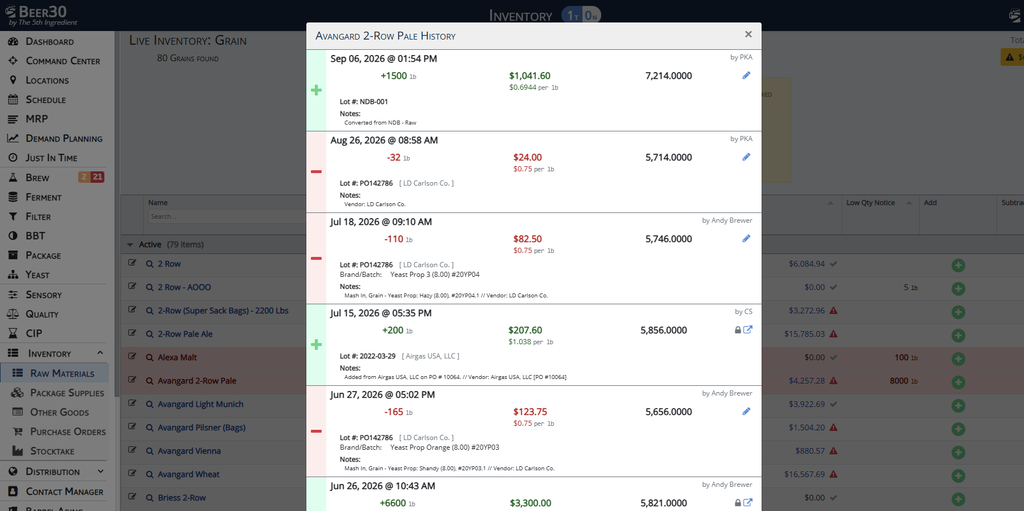
The same data that protects a brewery during a recall also improves the business every day. Lot-level inventory reduces uncertainty and provides accurate costing. Accurate batch records make quality investigations faster, and process improvements more obvious. Packaging traceability helps isolate defects and loss. Yeast genealogy supports fermentation consistency and prevents flavor drift. Sales traceability improves inventory visibility. It’s one big ecosystem to support a better brewery.
Beer30 was built to create this complete feedback loop: from raw-material receiving through brewing, fermentation, packaging, inventory, and sales. Instead of searching paper files or stitching together multiple spreadsheets, your team can identify which lots entered a batch, which finished products came from it, and where those products were sent.
A recall will always be disruptive. But it does not have to become chaos. With complete records, clear ownership, and a tested response plan, your brewery can protect consumers, preserve trust, limit unnecessary product loss, and get back to making great beer sooner.
Learn how Beer30 brewery management software provides true grain-to-glass traceability, or request a free demo from our team of industry veterans and experts.
A beer product recall is an action taken to remove an alcohol beverage from the market because of a potential safety, quality, labeling, contamination, adulteration, or regulatory issue. A brewery may initiate a voluntary recall itself or act following a request from TTB or another regulator.
A recall generally addresses a product that violates certain laws or presents a meaningful regulatory or health concern to customers. A market withdrawal generally removes product for a minor issue that would not normally trigger regulatory action, such as a routine quality problem without a health or legal risk.
A brewery should be able to connect supplier lots, receiving records, yeast history, actual batch production, transfers and blends, quality results, packaging material lots, finished-goods batches, inventory movements, sales orders, and delivery destinations.
There is no single, universal time target for every brewery, but the exercise should be timed and completed as quickly as practical. The goal is to identify all affected inputs and destinations, reconcile the full quantity, and expose any missing records or response gaps before a real incident ever occurs. Breweries should also be prepared for regulatory requests that may require records on a shorter timetable.
Yes, if its spreadsheets are complete, current, controlled, fully accessible, and capable of connecting materials to batches and batches to customers. As production and distribution become more complex, however, disconnected spreadsheets increase the risk of missing, duplicated, or outdated information. Plus, a lot of double-handling of data, which is never fun. Brewery management software such as Beer30 centralizes those relationships and makes traceability reports faster to produce.
Grain-to-glass traceability connects incoming ingredients and packaging materials to brewing, fermentation, quality, packaging, inventory, and sales records. True traceability also works in reverse, allowing a brewery to start with a customer, package code, beer batch, or supplier lot and reconstruct the entire history.

