
Running a profitable brewery requires more than making great beer and growing your sales. You also need to know what every batch, in every format you offer, truly costs to produce.
That’s why tracking COGS closely is so critical. In case you’re new to the world of beer-related finance, COGS is simply the total cost of the beer sold during any specific period. It generally includes the ingredients, production inputs and packaging materials directly associated with that beer. Tracking accurate COGS helps a brewery price products, evaluate margins, manage inventory, identify losses and make better production decisions before they come back to bite them later.
The basic COGS formula isn’t hard. It’s just:
Beginning inventory + purchases and production costs - ending inventory = COGS
That formula is simple, but producing a reliable number on your own is not. Brewery inventory moves through raw materials, then into tanks, and then becomes finished beer/seltzer/cider/etc before it is sold. Beer may also be transferred, blended, split into variants or packaged in several formats. If those movements are not recorded accurately, product costs and margins can become a nightmare to follow, and you may actively be losing money without realizing it!

Brewery COGS usually includes the costs directly associated with producing and packaging the beer that was sold to the market. Depending on the brewery's accounting policies, these may include:
COGS should not become a catch-all for every business expense. Sales expenses, marketing, taproom payroll and general administrative costs are typically operating expenses rather than product costs. Rent, utilities, depreciation and other production overhead require a consistent policy: some breweries allocate appropriate manufacturing overhead to inventory, while others use a simpler internal costing model.
The important thing is to be consistent, and to use the methodology that makes the most sense for your own operations. Work with your accountant to define what your brewery includes in inventory and COGS, then apply that policy the same way from period to period.
Revenue alone can’t tell you whether a beer, format or sales channel is profitable.
To make a long story short, you don’t put revenue in the bank. You put PROFIT in the bank.
A product can sell well while having a poor profit margin because of high ingredient costs, poor yields, low fills and dumped batches, or even simply going out of code too quickly.
Accurate COGS allows brewery operators the visibility they need to answer:
Without trustworthy production and inventory data, those answers are often based on outdated recipe estimates or overly broad averages. Actual costing creates a clearer connection between what happened on the production floor and what appears in the financial statements. And that is the information you need to make the right strategic decisions for your business.
To calculate brewery COGS correctly, costs must follow inventory through three stages.
Before brewing ever begins, malt, hops, yeast, adjuncts and packaging supplies are inventory assets. Their costs should be recorded when they are received and reduced as they are consumed.
Accurate raw-material costing depends on more than just knowing how much you;re supposed to have on hand. Breweries should also track:
The more you know about your inventory, the more accurate you will be able to project exactly how much cash will be coming back into the business. And importantly, the better you will be able to make decisions about contracts, spot market purchases, and recipe adjustments that may impact your bottom line.

When ingredients are used to brew a beer, their value moves from raw-material inventory into work in process, usually just known as WIP. This represents the accumulated cost of all your beer that has entered production but has not yet finished fermenting and been packaged into finished goods.
WIP can become complicated because beer rarely moves through a perfectly linear process. A brewery may:
A reliable costing system should track each of these, and keep an eye on any changes as your beer changes and moves. If a 15BBL base beer is divided into two variants, for example, the cost of the each batch should be the same as the volume that transferred over to each. Any additional ingredients or processing costs should then be added to the appropriate variant. Easy concept, but it can get messy in a hurry.
Tracking actual volume at each stage matters just as much as tracking spending. Lower-than-expected yield spreads the accumulated costs across less beer, increasing the real cost per barrel/hectoliter or case.

Once beer is packaged and ready for sale, its value moves from WIP into finished-goods inventory. Packaging materials, packaging losses and any applicable third-party costs such as mobile canning need to be added at this stage.
The same beer can have significantly different unit economics depending on its format. A half-barrel keg, sixtel and 24-pack of cans may contain the same liquid, but each uses different materials, labor and distribution costs. With that in mind, breweries should always calculate costs by the individual SKU (beer plus format) rather than relying only on one average cost for the brand.
Finished-goods costing should account for:
When the finished product is sold, its inventory value moves to COGS. Until then, it remains an asset on the balance sheet.

Once your COGS is accurate, a brewery can calculate gross profit:
Net sales - COGS = gross profit
Gross margin expresses that gross profit as a percentage of net sales:
Gross profit / net sales x 100 = gross margin percentage
For example, if a brewery records $100,000 in net sales and $60,000 in COGS, gross profit is $40,000 and gross margin is 40%.
Gross profit is not the same as net profit. Operating expenses such as sales, marketing, admin payroll, insurance and other costs still need to be deducted. Gross margin is nevertheless one of the clearest ways to evaluate whether production costs, pricing and sales mix can support the rest of the business.
A target cost gives you a useful benchmark to reference, but it shouldn’t replace actual batch costing. Comparing the two helps a brewery find exceptions that require attention.
When actual cost is higher than target cost, dig into:
The goal is not to just report a variance. It’s to identify why it occurred and decide what to change before the same issue affects future batches. Brew proactively, not reactively.
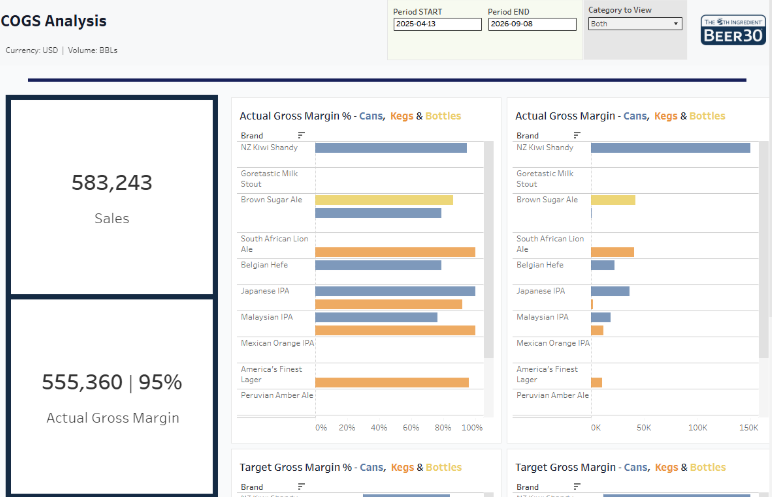
COGS becomes more valuable when it’s connected to operational performance. Review these metrics by brand, batch, packaging format, and reporting period:
Without tracking all of the metrics that can impact your brewery’s margins and success, it’s harder to put knowledge into action. Batch-level and SKU-level analysis makes it easier to locate the specific product, process or package behind a changing margin, and to do something about it.
Many costing problems begin with small gaps in day-to-day data collection. Common mistakes include:
Strong COGS reporting starts with consistent transactions: receive materials, record usage, measure transfers, capture losses, complete packaging runs and reconcile physical inventory.
Spreadsheets can estimate your products’ costs, but they become difficult to maintain as a brewery adds brands, formats, locations, staff, and process complexity. Brewery management software connects inventory movements with the work that created them.
Beer30® helps breweries track raw materials, production, WIP, packaging, and finished goods in one system. Your costs remain connected as beer moves through double and triple batching, transfers, tank splits, blends, and packaging runs, allowing teams to review actual cost by batch, volume, and packaged item.
Beer30 also allows production teams to record brewing data in real time without stopping your brew day because an invoice or inventory receipt hasn’t been entered yet. Your inventory details can be reconciled afterward, while your production team can brew without issue. And best of all? No issues with drifting or inaccurate costs or inventory counts..
With accounting integrations for QuickBooks Online, Xero, NetSuite, and others, Beer30 can also help reduce duplicate entries and align your brewery’s inventory and depletions with your actual finances. The result is a more traceable path from ingredients and production to the brewery's balance sheet and income statement.
Accurate reporting is only useful when it changes decisions. Brewery leaders can use COGS data to:
The best process is one that improves as it evolves: establish a target, capture actual results, investigate meaningful variances, take action, and measure whether the change improved the next batch.

