
Hello Craft University students, and thank you for supporting our efforts to help bring more actionable information and insights to breweries of all sizes and business models. With that in mind, we will occasionally be sharing articles from some of the top experts from across the industry, to help leverage their knowledge and connections for your benefit.
With that in mind, below is the first in a series of quarterly freight reports by the fantastic folks at Brew Movers, one of our Beer30 Marketplace Preferred Vendors. We hope you enjoy it, and that it helps with planning as you explore distribution, festivals, and long-distance transportation and freight in the coming months.
Cheers!
As we step into 2026, I wanted to share a quick update on what we’re seeing across the freight market and what it may mean for shippers in the months ahead.
After a long stretch of uncertainty, freight demand appears to be stabilizing in several key sectors. At the same time, capacity is gradually tightening as the market adjusts. When fewer trucks are available, service expectations can shift quickly, and pricing often becomes more sensitive to regional demand, seasonal changes, and lane-specific conditions.
We are also seeing early signals that rates are beginning to respond. Spot market movement is one of the clearest indicators, and recent spikes suggest we may be heading into a more volatile pricing environment than what many shippers have experienced recently.
The key takeaway is that 2026 may look more balanced than the past few years. Shippers who plan ahead, build flexibility into their timelines, and strengthen their carrier relationships will be better positioned to manage both cost and reliability.
If you’d like additional context, here are a few industry reads we’ve been following:
● Truck transportation jobs flat in December, lowest since 2021
● State of Freight: a depressed trucking market suddenly comes to life
● Truckload spot rate spikes are telling us something
At Brew Movers, we help shippers navigate market shifts with proactive planning, dependable execution, and clear communication. If you would like to talk through your freight strategy for 2026, we would be happy to connect.
Warm regards,
Brandon Arnold
COO, Brew Movers
By Ryan Mayfield of Craft Leadership
There comes a moment in every brewery’s life when growth stops feeling exciting and starts feeling exhausting. The tanks are full, the taproom is busy, the distributor is calling, and suddenly the same creative energy that launched your brewery now fuels 80-hour weeks, endless decisions, and the creeping worry that you’re losing the magic that made you special.
Scaling up isn’t just about producing more beer; it’s about multiplying leadership, communication, and trust. Without that foundation, growth quickly becomes chaos. The good news is that you can expand without losing yourself, your people, or your culture, but only if you grow intentionally.
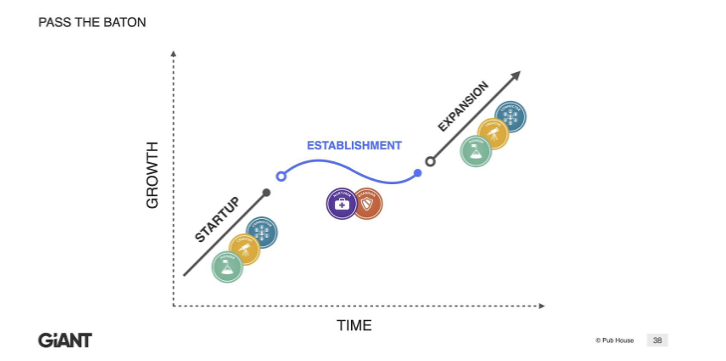
Breweries evolve in distinct phases, and each phase demands different leadership strengths. In the Pass the Baton tool, the journey moves through Startup, Establishment, and Expansion, each powered by different kinds of leaders.
● Startup: When you first launch, energy and innovation are everything. You need big ideas, bold risk-takers, and relentless drive. This is where the Creative* and Pioneer* voices shine; they see the vision before anyone else can.
● Establishment: Once things stabilize, the focus shifts to consistency, systems, and culture. The brewery now needs Nurturers* and Guardians* to bring structure, clarity, and sustainable rhythm.
● Expansion: As you grow into regional or national distribution, leadership must again shift gears. This phase demands Pioneers* and Connectors*, people who can cast vision, build partnerships, and inspire others to carry the mission forward.
Many breweries get stuck between Establishment and Expansion because the founders never pass the baton. They are still trying to do everything themselves: brewing, managing, selling, hiring, long after the business outgrew that model. The result is burnout at the top and confusion everywhere else. Growth isn’t just about doing more; it’s about empowering more people to lead well.
*Don’t Know Your Voice Yet?
Every leader operates from a natural “voice,” the way they see the world and influence others.
Before you start scaling, take the free 5 Voices Assessment to discover your leadership voice: yourteamworkcoach.giantos.com/store/5-voices.
Knowing your voice helps you understand what you naturally bring to each growth phase and where you might need to invite others to balance your leadership.
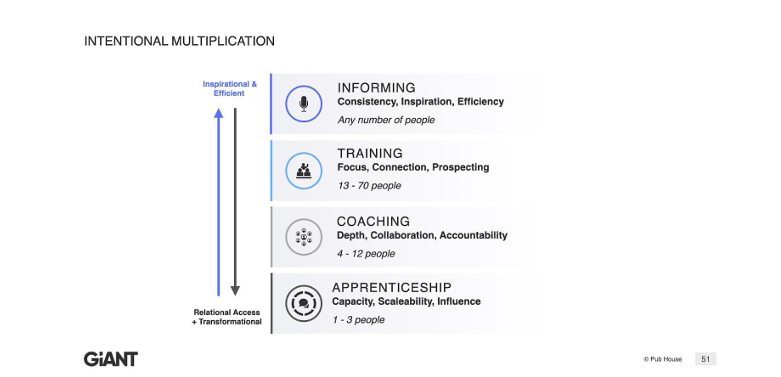
Scaling sustainably requires more than adding tanks and tap handles; it requires multiplying clarity, communication, and capability. The Intentional Multiplication framework outlines four layers of growth that every healthy organization cycles through:
1. Informing – This is how you reach everyone. Use this layer for consistency and inspiration: team updates, newsletters, or all-staff meetings.
○ Focus: Consistency, Inspiration, Efficiency
○ Reach: Any number of people
2. Training – Focused sessions for groups of 10–70 people. Teach specific skills or processes that reinforce your culture.
○ Focus: Focus, Connection, Prospecting
○ Reach: 13–70 people
3. Coaching – Small groups (4–12 people) where accountability, collaboration, and growth happen. This is where leaders learn to apply what they’ve been taught.
○ Focus: Depth, Collaboration, Accountability
4. Apprenticeship – The deepest level of transformation. You invest in one to three individuals, giving them real responsibility and walking with them as they learn to lead.
○ Focus: Capacity, Scalability, Influence
Most breweries stop at training, holding meetings, creating SOPs, or sending people to a class. But training alone doesn’t multiply leadership. Real multiplication happens at the coaching and apprenticeship levels, where values and habits are transferred through relationship, not PowerPoint slides.
To scale your brewery without losing your culture, you must scale your people development with the same intentionality that you scale your production.
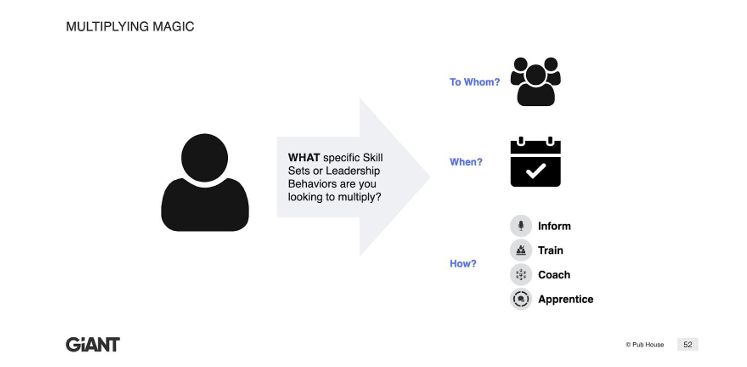
Once you know what to multiply, the next step is to systematize how it happens. The Multiplying Magic tool breaks it down into three simple questions:
1. What specific skills or leadership behaviors are you trying to multiply?
○ Examples: clarity in communication, delegation, coaching habits, cross-department collaboration.
2. To whom are you multiplying them?
○ Department leads? Shift brewers? Taproom managers?
3. When and how will you do it?
○ Through weekly meetings? Apprenticeship pairings? Monthly coaching calls?
Example:
Your head brewer has mastered consistent quality and recipe handoffs. Instead of trying to oversee every shift, they coach one or two shift leads on process ownership. Those leads then apprentice others, multiplying quality through people rather than control. Meanwhile, the GM trains department heads to use structured communication tools in meetings. The owner holds quarterly “Informing” sessions to share the big picture and celebrate progress.
When you align these layers, your brewery becomes a leadership machine, each person learning, applying, and teaching the next.
Scaling culture is harder than scaling beer, but it’s far more valuable. When your brewery opens new locations or expands distribution, your “way of working” gets tested. Without structure, every team will invent its own version of your culture.
Here’s how to protect what matters most:
● Codify your core values. Write down what they look like in action. For example, if “community” is a value, define how it should show up in both customer interactions and internal relationships.
● Create a simple leadership playbook. Outline your meeting rhythms, feedback tools, and conflict-resolution process. Consistency creates confidence.
● Make culture part of onboarding. Every new hire should understand not just what you do, but why you do it that way.
● Train your trainers. Every new location or department should have someone who can both embody and teach your culture.
● Model rest and boundaries. If the owner never takes a day off, the team won’t either. Leadership burnout is contagious.
Culture doesn’t scale by accident. It scales by design.
Expanding from a small brewhouse to regional or national distribution is one of the hardest transitions a brewery can make. The temptation is to chase growth at all costs, but the true cost of growth done wrong is your people, your quality, and your peace of mind.
The breweries that endure are the ones that grow on purpose. They don’t just multiply production; they multiply leadership. They know when to pass the baton, when to inform, when to coach, and when to rest.
So here’s your challenge:
This quarter, identify one behavior or leadership habit your team needs to multiply: clarity, consistency, accountability, or collaboration, and build a simple rhythm around it.
Because scaling up doesn’t have to mean burning out. With intentional systems, a strong culture, and shared leadership, you can grow your brewery and keep your soul intact.
Eight years ago, on October 17, 2017, Pulkit K. Agrawal founded The 5th Ingredient on a simple idea: travel the world and help breweries use their data to make better process improvement decisions.
At the time, brewing software was often clunky, siloed, or too focused on accounting. Brewers were juggling spreadsheets, paper logs, and sticky notes, trying to keep track of everything from raw ingredients to finished beer.
During those travels, Pulkit saw an opportunity: what if data could help breweries optimize their processes not just to survive, but to thrive? From there, the idea of Beer30 was born!
Today, Beer30 serves breweries worldwide, from small craft operations to larger multi-location facilities. With over 450 breweries in 24+ countries using Beer30, we’ve learned as much from the industry as the industry has learned from the data we’ve provided.
Craft beer has evolved. Production schedules have become more complex. Consumer expectations have skyrocketed. And one truth has become clearer than ever: good beer alone isn’t enough to succeed. Breweries need good data.
When we launched, the first version of Beer30 was modest. But even with a minimal feature set, it quickly became clear: breweries are hungry for solutions that give them insight into what’s happening in their operations.
We saw teams spending hours chasing lost inventory or trying to reconcile batches after the fact. Mistakes are costly, not just financially, but also in terms of customer satisfaction and wasted product.
Our mission was to simplify the complex, make data actionable, and give brewers confidence that their operations were under control.
The brewing industry itself has evolved dramatically in eight years. Craft beer is no longer just a niche market; it’s a highly competitive, fast-moving landscape. In this environment, “winging it” doesn’t work anymore. Forecasting, inventory management, and operational oversight have become critical to survival.
Breweries that embrace technology and data are the ones that not only survive, but thrive. They can plan production with precision, reduce losses, manage costs, and respond to market demand before it shifts—those who don’t risk overproduction, understocking, or missing opportunities entirely.
Looking back, there are eight lessons we’ve learned from working alongside breweries, which we believe reflect how the industry is changing and what it takes to succeed:
As Beer30 celebrates its eighth anniversary, our focus is on the future. The industry will continue to evolve. Breweries will continue to scale, innovate, and face challenges we can’t yet predict. Our role is to make sure they have the tools, insights, and confidence to navigate those changes successfully.
We’ve always believed that great software should help brewers focus on their craft, not bog them down with administrative busywork, and eight years later, that mission is stronger than ever. The breweries we serve are proof that when passion meets data, efficiency meets creativity, and community meets quality, the result is something remarkable: beer that delights, operations that thrive, and businesses that last.
Here’s to eight years of growth, lessons learned, and the future of brewing smarter, not just bigger. Cheers and beers!
====================================================
Today, October 17, 2025, marks 8 incredible years of The 5th Ingredient! 🍻
From our very first brewery onboarding to having 450+ breweries using Beer30 and Bucha30 daily, it’s been one wild, wonderful ride. We’re endlessly grateful for the community that has grown with us: our customers, partners, and friends who’ve believed in data-driven brewing since day one.
Over the past 8 years, we’ve logged thousands of product updates, toasted numerous beers at conferences, and shared even more laughs and selfies along the way.
Through it all, our mission remains the same: helping breweries #BrewMore and #BrewBetter.
Here’s to continuing to support brewers, innovating our software, and making the next 8 years even more exciting than the last.
Cheers to the brewers, the dreamers, and the doers who make this all possible. 🍻
Do you have a favorite Beer30 memory or photo? Drop it in the comments!
Across the U.S., more breweries are expanding into distilling to diversify revenue and attract new customers. From whiskey and gin to ready-to-drink cocktails, craft beer brands more than ever see spirits as a natural next step. But there’s one big challenge breweries run into right away: shared ingredients.
When you’re juggling the same grains, yeast, barrels, and packaging across beer and spirits, it’s easy for costs to get lost in the shuffle. And if you’re tracking inventory in spreadsheets, you may never know which side of your business is really profitable.
That’s why forward-thinking breweries are turning to brewery management software like Beer30.
On paper, adding distillation to your brewery sounds simple: you already order malt and grain, so just allocate some to whiskey. You’ve already got packaging suppliers, so why not bottle both beer and spirits?
But in practice, things get messy fast:
Without accurate brewery software, costs slip through the cracks, and margins disappear without anyone noticing.
Why Shared Ingredients Can Sink Your Margins
Spirits production ties up more time, tanks, and raw materials than beer alone. If costs aren’t tracked precisely:
The solution? A single source of truth with brewery management software.
Beer30’s Command Center gives breweries a real-time view of their operations. Instead of juggling disconnected spreadsheets, you get one platform to manage it all.
This is where brewery software stops being “nice-to-have” and becomes essential for growth.
When breweries add distilling, shared ingredients like grains, yeast, and packaging make it hard to know your true cost of goods sold (COGS). That’s where Beer30’s brewery software inventory reports come in.
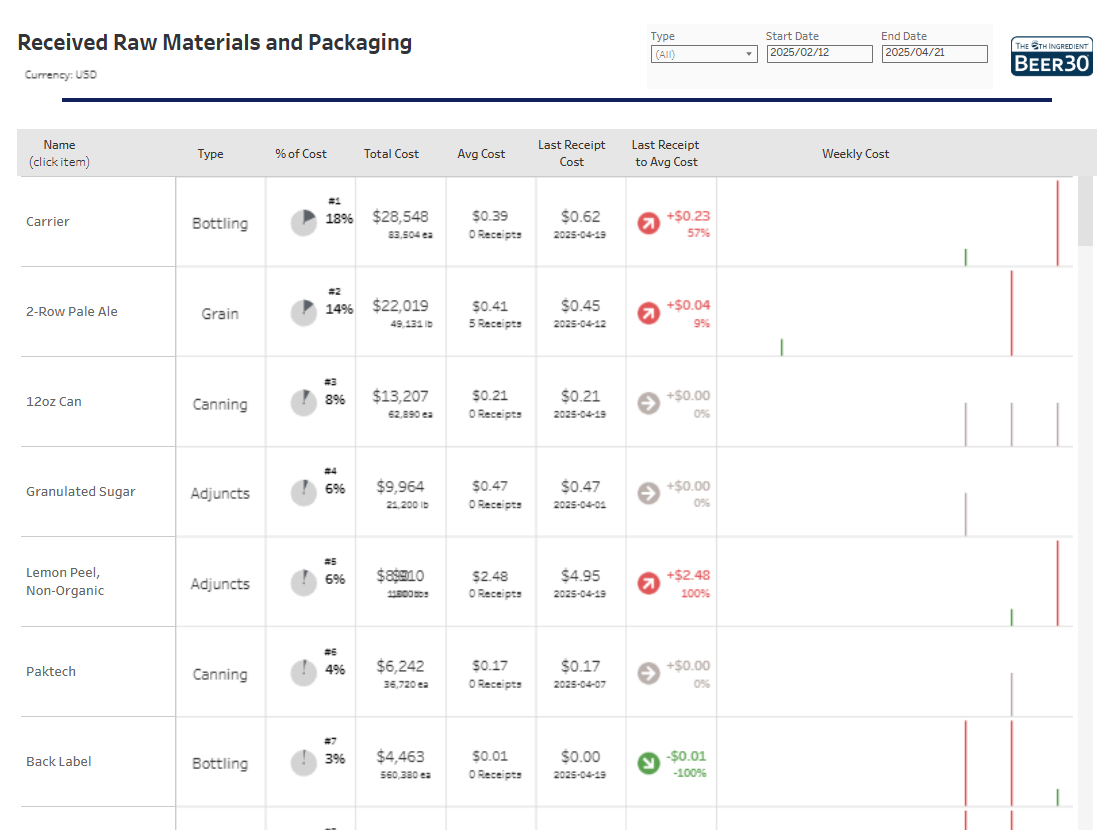
Received Raw Materials & Packaging Report
This report gives you complete visibility into how much you’re spending on every input your beer or spirits need, along with cost changes over time. You’ll catch price fluctuations immediately instead of finding out at the end of the month, giving you the power to respond quickly to protect your margins and accelerate your business.
Raw Materials & Packaging by Brand Report
This view ties ingredient usage directly to each brand, whether it’s beer or spirit. Whether it’s 2-Row Pale Ale going into your IPA or into a whiskey mash, you’ll see exactly where costs are allocated.
Raw Materials & Packaging Usage Visualization
This advanced report lets you follow the entire flow of ingredients from grains, hops, adjuncts, packaging supplies, and more to see what products they flow into and how important they are to your portfolio of products. You’ll be able to visualize better than ever your supply chain, your dependencies, and what raw materials are most important to secure for the future of your business.
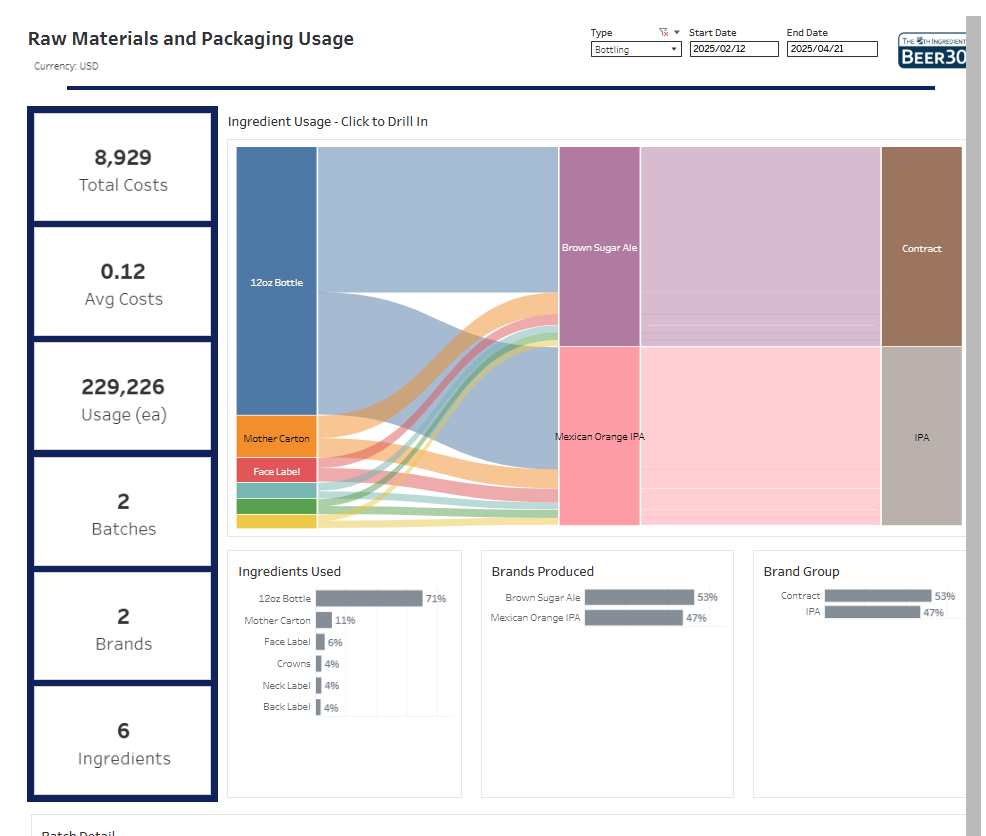
Adding distillation can unlock major growth for breweries, but only if you keep costs under control. Shared ingredients are a hidden trap that can eat away at profitability if you’re not tracking them carefully.
With Beer30’s brewery software, inventory reports, and Command Center, you’ll have the visibility to expand into spirits without losing sight of your beer margins.
Ready to see how the best brewery software can transform your operations? Schedule a demo of Beer30 today.
The craft beer market is competitive. Tasting rooms are full of choice, distribution channels are crowded, and consumer preferences are always evolving. That’s why more breweries are turning to a variety of ways to diversify, including distilling.
From small-batch whiskey to botanical gins to ready-to-drink cocktails (RTDs), spirits open the door to new audiences, higher margins, and a different kind of brand storytelling. But the decision to start distilling isn’t as simple as “why not?”. It’s a significant business move that deserves serious thought.
Here’s how to know if your brewery is ready to make the leap.
Is there room in your local market for another distillery? A quick scan of your area’s spirits scene can reveal whether you’d be fighting for shelf space or filling a gap with any particular product type. Even in saturated beer markets, there may be opportunities for a spirits brand with a fresh identity, especially if you can leverage your existing brand and you’re able to use your taproom as a built-in tasting space. And more even than in craft beer, national and international brands have a prominent place in the market. Don’t forget to consider their influence, either!
Adding spirits isn’t just about production; it’s about alignment. Does your brand naturally lend itself to spirits? If so, what kind(s) would be a good fit? If your brewery is known for bold, experimental flavors, maybe a creative gin line fits. If your reputation is built on traditional craftsmanship, a classic whiskey might resonate better. Do what feels right for you and your business, and be careful about diluting your brand identity if it’s not a great fit. You can always spin off a new brand if you need to, and oftentimes it can help build an identity that is all its own.
Distilling requires more than equipment; it takes time, training, and a different set of safety protocols. If your team is already stretched thin, you’ll need to plan for staffing and skill development. Hybrid operations that thrive often have dedicated people for both brewing and distilling, with crossover knowledge to keep things efficient. Remember that focus is a resource, just like cash, grain, or equipment. Use it wisely, and don’t let a new opportunity become a distraction instead of an asset.
The startup costs for distilling can be substantial, especially if you’re making spirits that need to age. Unlike beer, which generates revenue quickly, aged spirits can tie up your cash for months or years before your first bottle sells. Having a clear cash flow plan and visibility into your cost of goods is critical.
Running beer and spirits under one roof means tracking two sets of regulations, two sets of processes, and two sets of inventory flows.
This is where a good brewery management system like Beer30 comes in. With custom workflows for breweries, distilleries, and hybrid operations, Beer30 lets you:
By streamlining the data side, you can focus on the creative and operational decisions that make distilling worth the leap.
Learn More in Our Free Webinar

If you’re curious about taking your brewery into spirits, join us for:
From Suds to Spirits: Taking Your Brewery into the World of Distilling
When: August 27, 3 pm ET / 12 pm PT
Where: Online – https://the5thingredient.com/spirits
Aaron MJ Gore from Beer30 will be joined by Kyle Wortz from Trillium and Brandon Seaman from DISTILL x 5 to dive deeper into the real-world legal, operational, and financial considerations of distilling, plus lessons from brewers who’ve made the jump.
Whether you’re just starting to explore the idea or already making plans, you’ll leave with the clarity to decide if distilling is the right move for your brewery.
Distilling can be an incredible way to expand your brand, diversify your offerings, and tap into new markets, but it’s not a one-size-fits-all solution. The most successful brewery–distillery hybrids enter the space with a clear vision, solid operational systems, and a commitment to quality on both sides of the business. By taking the time to assess your readiness now, you set yourself up for a smoother, more profitable transition later.
If you’re interested in learning more about Beer30 brewery software, book a demo today, and let’s chat!
The craft beer market isn’t what it used to be.
As consumer tastes shift, breweries are no longer just breweries; they’re beverage brands. From hard seltzers and THC-infused drinks to ciders, non-alcoholic options, and even nootropic beverages, today’s brewers are branching out far beyond beer.
But with innovation comes complexity. And that’s where the right brewery software becomes your secret weapon.
At Beer30, we’ve seen firsthand how brewers are evolving, and we’ve built tools to support that evolution.
Why Diversification is the New Standard
Let’s face it: not everyone walking into your taproom is asking for a double dry-hopped IPA anymore.
If your brewery wants to stay relevant and competitive, expanding your product lineup is no longer a “maybe.” It’s a must.
New beverage types come with new challenges:
Trying to manage all of this in spreadsheets or generic software? That’s a recipe for errors, delays, and headaches.
Here’s how Beer30 brewery software gives you the structure, insight, and flexibility to scale your beverage lineup without sacrificing sanity.
Beer30 was designed for beer, but it can handle a wide variety of brews. You can easily create and track batches for:
Customize every batch’s workflow, ingredients, and QA checkpoints without needing to create workarounds.
When you start producing multiple product lines, understanding the cost per unit becomes mission-critical.
Beer30 tracks your:
You’ll know exactly how profitable each new beverage is—and whether it’s time to double down or pivot.
Want to use the same strawberry purée in a sour beer, a cider, and a THC seltzer? Beer30 provides full traceability and depletion tracking across all your SKUs.
You can even filter by ingredient usage by brand, so your purchasing team isn’t left guessing.
Cannabis beverages and nootropics require tight compliance with evolving regulations. Beer30 helps by:
Peace of mind = priceless.
When you're exploring new product lines, data is power, but context is king.
With Beer30’s dashboards and reporting tools, you can:
Your brewery isn’t static. You’re experimenting, evolving, and trying to capitalize on the next big thing. Your software should do the same.
Beer30 is built for modern beverage producers, whether you’re brewing beer, blending botanicals, fermenting fruit, or formulating functional drinks.If you’re ready to move from spreadsheets to a system that supports your entire beverage lineup, let’s talk.
The next big shift in craft brewing might not come from a hop farm; it could come from a dispensary.
As consumer preferences evolve, breweries are finding themselves at a crossroads: keep doing what’s familiar, or start exploring bold new frontiers like cannabis-infused beverages (cannabev). And while THC- and CBD-based drinks still carry a whiff of novelty, they're gaining traction, fast.
In 2025, brewers across the country are looking beyond the IPA and asking: Is this where the market is going?
If so, how do we navigate legal constraints, make it safe, and make it profitable?
Cannabis beverages, or cannabevs, are no longer a fringe idea. In fact, the market is projected to surpass $2 billion globally in the coming years. Young consumers, especially those seeking a lighter buzz without the alcohol or calories, are showing growing interest in THC- and CBD-infused drinks, and they are increasingly finding a place in their lives and social occasions.
What makes this space so compelling is that breweries already have many of the resources to compete: production facilities, branding experience, cold-chain distribution, and direct-to-consumer channels. But it’s not just a matter of throwing THC into your next seltzer. Entering the cannabev market brings its own unique set of challenges.
Getting into cannabis beverages isn’t like launching a seasonal sour. It requires a strong grasp of regulations, ingredient logistics, and batch-level precision. For breweries relying on spreadsheets or scattered systems, the complexity can quickly spiral.
To succeed, you’ll need to:
Without a centralized brewing software to manage this data, it's easy to lose visibility and confidence.
To produce cannabis beverages with accuracy and compliance, you may need to go beyond spreadsheets. With government regulations keeping tabs on cannabev production, you need a software platform that can adapt to your evolving operations. Beer30 was designed specifically for modern craft beverage producers and is ideal for those entering the THC or CBD beverage market.
With Beer30, breweries can:
Whether you’re brewing beer, hop water, seltzers, or THC-infused drinks, Beer30 gives you the operational foundation and best-in-the-industry reporting to move fast without cutting corners.
With all of the regulations and laws surrounding Cannabis beverages, it may be making your head spin just thinking about it. But don’t worry, we’re here to help.
We’re hosting a free webinar to help answer all of these questions and more!

If you’re thinking about getting into the Cannabev space and want to learn more, check out our free educational webinar: Brewing with Bud – Navigating the Next Big Opportunity in Brewing
Aaron MJ Gore and our panel will go over everything brewers need to get started in the cannabis beverage space without flying blind.
Aaron will be joined by panelists:
Together, they’ll walk through what it actually takes to get into cannabevs, from regulatory concerns to ingredient sourcing, equipment needs, and how brewery software like Beer30 supports it all.
Expect a candid, step-by-step look at:
Join us on July 23rd at 3 PM EST.
Visit the5thingredient.com/cannabev to register today!
This isn't just another product line. It’s an opportunity to diversify your revenue, connect with new customers, and get ahead of a trend that’s not going away.
But entering this space without the right tools is risky. Regulations are strict, ingredients are complex, and margins depend on efficiency. Using a brewery software like Beer30, which can handle multiple product types, provide real-time tracking, and offer compliance visibility, will prepare you to kick off production.
Join us on July 23rd for our free webinar and learn what it takes to build a cannabev program that actually works.
To learn more about Beer30, the brewery software that’s changing the game, book a demo today for a quick chat!
Running a brewery is a balance of art, science, and business. While crafting a great beer is at the heart of it all, long-term success comes down to smart decision-making backed by real, timely data. Like any business, if you’re not making money, you’re not going to last. Two of the most important metrics every brewery should be actively tracking are Sales and COGS (Cost of Goods Sold). When you understand how much you're selling and what it's costing you to make each pint, you unlock the power to optimize your margins, scale smarter, and run a healthier operation overall.
Sales figures are more than just numbers; they tell a story and let you know what’s resonating with your customers at what times of year, where you're growing, and which parts of your business need attention.
By tracking sales broken down by brand and brand type, you can see exactly which beers are driving revenue. This insight helps you prioritize production, dial in your marketing efforts, and make sure your flagship beers are performing as expected. If you analyze performance by format, such as cans, bottles, or kegs, you can understand packaging preferences and align your production accordingly.
If your brewery has sales reps in the market, being able to view their individual performance can help you identify who’s excelling and who might need support. And for those distributing across multiple locations or taprooms, seeing sales data by city or market ensures you’re targeting the right areas and responding to real trends in real time.
It’s a lot of data to take in, but if you manage it correctly, it can tell you exactly what your next move should be.
On the flip side of the equation is your COGS. While sales are incredibly important, even a wildly popular beer can drain your bottom line if it’s not cost-effective to produce.
Tracking actual vs. target COGS allows you to spot problems before they spiral. If a specific brand is consistently over budget because of packaging inefficiencies, ingredient waste, or poor yields, visibility into those numbers allows you to dig into the root causes and correct the course quickly.
Viewing your COGS by time period allows you to recognize seasonal shifts or supply chain changes that may impact your costs. With raw material costs changing more quickly than ever, the sooner you can see changes coming and respond, the more money you’ll be able to bring back into the business to help you continue to thrive.
The Difficulty of Too Much Data
For many breweries, tracking sales and COGS starts with a spreadsheet. And while spreadsheets are flexible and familiar, they come with serious limitations. They’re often manually updated, which increases the chance of errors or outdated numbers. You might be relying on different sheets owned by different team members, with inconsistent formulas or conflicting information. It’s not uncommon for breweries to spend hours compiling reports, only to realize they’ve made a mistake or missed a trend entirely.
Plus, it can feel overwhelming and hard to find real insights with so much data to keep track of. The lack of organization that comes with using spreadsheets can cause owners and managers to get stuck in inaction. After all, if you don’t make a change, it can’t be THAT bad, right?
Well, much like the holy trinity of rock and roll, Rush (and maybe some other guy) told us, “If you choose not to decide, you still have made a choice.” So if you’re overwhelmed by your spreadsheets and frantically wasting time trying to connect the dots a la Charlie Day, then why even collect the data?
You need to be able to decipher your data and make actionable decisions (bonus points if you can do that without wasting hours trying to make sense of it all).

This is where brewery management software like Beer30 shines. Beer30’s Command Center is your centralized hub for brewery insights, designed to put everything you need to know about your Sales and COGS in one place, updated in real time, and easy to use.
On the Sales Dashboard, you can see:
This allows you to assess performance from every angle and act quickly on what the data tells you.

On the COGS side, the Command Center gives you:
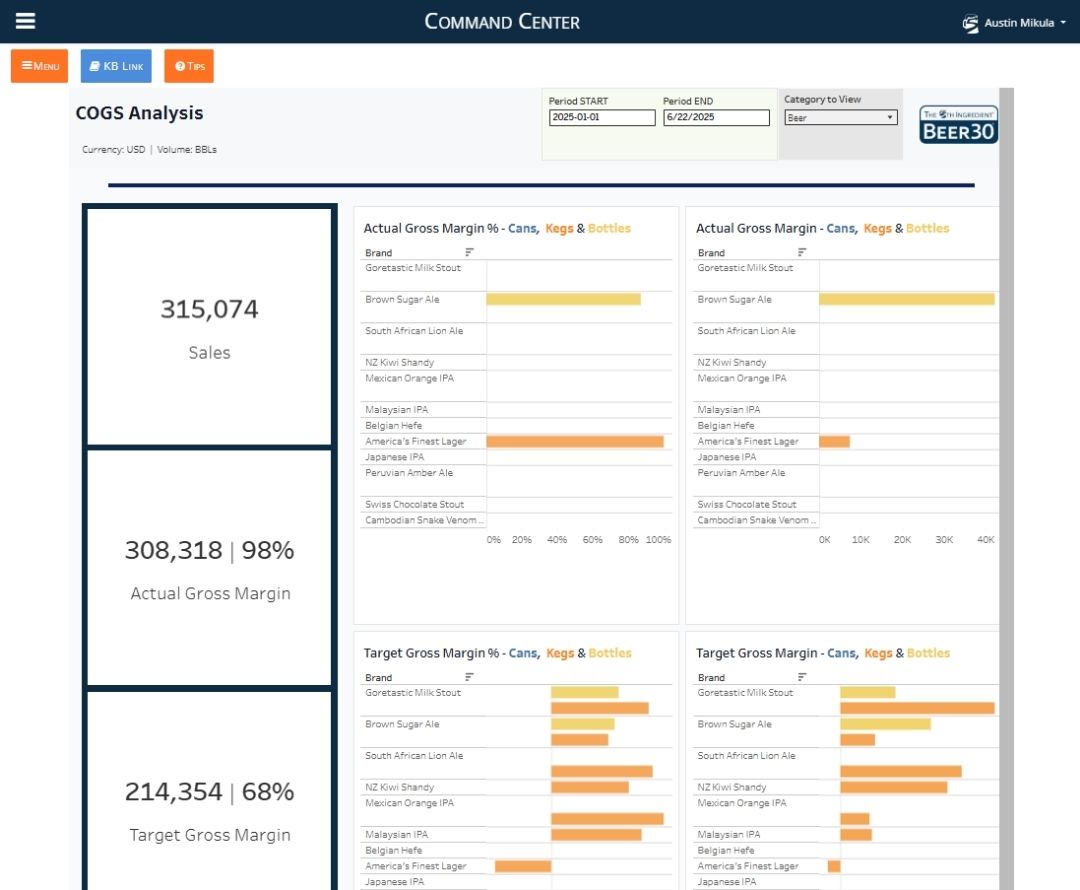
Together, these dashboards remove the guesswork and get you back to actually brewing beer. You’ll know what’s selling, how much it’s costing you, and where you can make small tweaks that drive major results.
At the end of the day, breweries that thrive are the ones that understand their business as deeply as they understand their brewing process. Tracking sales and COGS isn’t just good practice; it’s a competitive advantage that has become a necessity in a challenging market.
With Beer30’s Command Center, it’s never been easier to stay informed and in control.
Explore our Pricing & Features to find the Beer30 package that fits your brewery.
Running a brewery is like juggling chainsaws…if the chainsaws were also on fire. You're managing everything from grain deliveries and fermentation schedules to customer orders and profit margins. It's no wonder more and more brewery owners are saying, "enough with the chaos" and turning to brewery software to help get their operations under control.
But here's the thing: not all brewery software is created equal. So what should you actually be looking for?
Think of brewery software as the nervous system of your operation. It connects everything, from the moment grain hits your mash tun to when that beer lands in a customer's hands. While you can try to manage things with whiteboards, sticky notes, and a prayer, the lack of organization, time spent on labor, and lack of data involved aren’t sustainable for true growth. Brewery software is your solution for an all-in-one tracking system that saves you time and dials in your efficiency.
A solid brewery software platform doesn't just track stuff (though it does that really well). It actually helps you make better decisions by giving you real data instead of educated guesses.
Instead of wondering if you have enough pale malt for next week's batch or trying to remember which tank needs cleaning, your brewery software just tells you. It sends alerts when inventory runs low, tracks every batch from start to finish, and even calculates exactly how much each beer costs you to make.
Good brewery software should include:
When all these pieces work together, something magical happens. You stop fighting fires and start actually running your brewery.
Beer30 was founded by Pulkit K. Agrawal, who worked as a process engineer at Ballast Point. Since then, The 5th Ingredient has built a team of knowledgeable industry veterans. As we grow as a company, one of our main focuses is to bring on team members with a passion for brewing and the brewing process.
This brewery experience and passion for the industry is what sets Beer30 apart. Our team has created Beer30 to be proactive by design. Instead of just storing information, it actively helps you improve your brewing process with every single batch.
Here's what brewers are doing with Beer30:
It's like having a really smart brewing assistant that never sleeps and never forgets anything.
Beer30 recently launched the Command Center with their Cascade update. Think NASA mission control, but for beer.
This interactive dashboard gives you a complete view of your entire operation the moment you log in. No more clicking through a dozen different screens or hunting through reports to figure out what's happening right now. Want more detail on a specific data set? Just click into it.
The Command Center shows you:
Having all this information in one place means you can make decisions quickly and confidently, instead of second-guessing yourself or scrambling to find data.
Choosing brewery software shouldn't feel like solving a puzzle blindfolded. That's why we've created a detailed comparison showing how Beer30 measures against other brewery software options in the market.
Check out our complete Pricing and Features Comparison.
The right brewery software doesn't just help you manage your current operation, it helps take your operations to the next level and streamline your processes so you can focus on brewing beer. Tracking, analyzing, and optimizing everything in real-time, lets you worry less about survival and gives you more time to focus on growth.
Beer30, is leading the charge for craft breweries that want to scale up without losing their minds. Whether you're brewing your first commercial batch or expanding into new markets, having solid brewery software in your corner makes all the difference.
Ready to see what your brewery could look like with the right tools?
Book a demo with the Beer30 team today
Efficiency isn’t just about brewing more beer; it’s about brewing smarter and making sure you’re not losing money. For breweries of any size, maximizing batch efficiency is one of the most impactful ways to reduce costs, minimize waste, and improve profitability without compromising on quality. But to improve efficiency, you first need to understand where you’re gaining or losing ground.
So, let’s break down what batch efficiency really means, where inefficiencies often hide, and how to track and optimize your production using smart tools like Beer30’s new Batch Efficiency and Brew Length Reporting, part of the powerful Cascade Update.
Batch efficiency refers to how effectively you turn raw materials into packaged beer. It’s not just about yield, but also about time, loss, and the smooth handoff between stages in your brewing process.
Here’s where inefficiencies most commonly occur:
Ultimately, every lost gallon adds up, whether it goes down the drain, ends up as foam, or sits in a tank longer than needed.
To fix inefficiencies, you first have to see them. Tracking can take many forms, from manual spreadsheets to automated brewery software, but the goal is always the same: identify where beer is lost, where time is wasted, and where improvements can be made.
Compare key points in your production process:
These benchmarks help you isolate where the biggest losses are occurring.
Efficiency isn’t just about liquid, it’s about time.
If your brew sits in a fermenter or brite tank longer than needed, it’s costing you production capacity. Measuring throughput time per brand helps uncover slowdowns and optimize tank scheduling.
This is where the latest Cascade Update from Beer30 software makes a massive impact. Included in the brand-new Brewery Command Center, the Batch Efficiency and Brew Length report is designed to give you actionable visibility into every drop, every delay, and every step in your process.
Track losses from start to finish:
Quickly identify where volume is slipping across brew, filter, and package.
Visualize throughput time:
Understand how long it takes each brand to move from brew to final package, so you can improve turnaround time.
See loss percentages with clarity:
Total volume loss is shown visually with bar thickness representing packaged volume, making it easier to focus on high-volume or high-loss batches.
Drill down for insights:
Click into any brand to view batch-specific data, with tools to correct any anomalies via Batch History or Admin Edits. The data refreshes throughout the day, so you’re always looking at near real-time info.
Filter by date range:
Analyze any time period and include only the relevant batches that were brewed, filtered, and packaged during it. Even partially packaged beer is accounted for in loss calculations.
While it’s possible to track efficiency manually using spreadsheets and brew logs, it’s often time-consuming, error-prone, and disconnected across departments. That costs you money.
With Beer30, all your data is centralized, standardized, and visualized in real-time, giving you a clear picture of batch performance without the manual guesswork.
You’ll save hours of administrative time, reduce the risk of reporting errors, and empower your team to make faster, more informed decisions. Plus, with dynamic reporting like the Batch Efficiency and Brew Length dashboard, you’re not just recording what happened, you’re actively uncovering how to do it better next time and keeping stored data to continue improving.
Batch efficiency isn’t just a number; it’s a roadmap. When you understand where you’re losing beer or time, you can take real steps toward improvement. Whether you're adjusting processes, maintaining equipment more proactively, or implementing better filtration, small changes can yield big results.
With the new Batch Efficiency and Brew Length Report inside Beer30’s Command Center, you get the insight you need to make those changes confidently…and profitably.
Want to see the Cascade Update in action?
Book a demo or email us at pint@the5thingredient.com to learn more and start maximizing efficiency at your brewery. 🍻


