
Running a profitable brewery requires more than making great beer and growing your sales. You also need to know what every batch, in every format you offer, truly costs to produce.
That’s why tracking COGS closely is so critical. In case you’re new to the world of beer-related finance, COGS is simply the total cost of the beer sold during any specific period. It generally includes the ingredients, production inputs and packaging materials directly associated with that beer. Tracking accurate COGS helps a brewery price products, evaluate margins, manage inventory, identify losses and make better production decisions before they come back to bite them later.
The basic COGS formula isn’t hard. It’s just:
Beginning inventory + purchases and production costs - ending inventory = COGS
That formula is simple, but producing a reliable number on your own is not. Brewery inventory moves through raw materials, then into tanks, and then becomes finished beer/seltzer/cider/etc before it is sold. Beer may also be transferred, blended, split into variants or packaged in several formats. If those movements are not recorded accurately, product costs and margins can become a nightmare to follow, and you may actively be losing money without realizing it!

Brewery COGS usually includes the costs directly associated with producing and packaging the beer that was sold to the market. Depending on the brewery's accounting policies, these may include:
COGS should not become a catch-all for every business expense. Sales expenses, marketing, taproom payroll and general administrative costs are typically operating expenses rather than product costs. Rent, utilities, depreciation and other production overhead require a consistent policy: some breweries allocate appropriate manufacturing overhead to inventory, while others use a simpler internal costing model.
The important thing is to be consistent, and to use the methodology that makes the most sense for your own operations. Work with your accountant to define what your brewery includes in inventory and COGS, then apply that policy the same way from period to period.
Revenue alone can’t tell you whether a beer, format or sales channel is profitable.
To make a long story short, you don’t put revenue in the bank. You put PROFIT in the bank.
A product can sell well while having a poor profit margin because of high ingredient costs, poor yields, low fills and dumped batches, or even simply going out of code too quickly.
Accurate COGS allows brewery operators the visibility they need to answer:
Without trustworthy production and inventory data, those answers are often based on outdated recipe estimates or overly broad averages. Actual costing creates a clearer connection between what happened on the production floor and what appears in the financial statements. And that is the information you need to make the right strategic decisions for your business.
To calculate brewery COGS correctly, costs must follow inventory through three stages.
Before brewing ever begins, malt, hops, yeast, adjuncts and packaging supplies are inventory assets. Their costs should be recorded when they are received and reduced as they are consumed.
Accurate raw-material costing depends on more than just knowing how much you;re supposed to have on hand. Breweries should also track:
The more you know about your inventory, the more accurate you will be able to project exactly how much cash will be coming back into the business. And importantly, the better you will be able to make decisions about contracts, spot market purchases, and recipe adjustments that may impact your bottom line.

When ingredients are used to brew a beer, their value moves from raw-material inventory into work in process, usually just known as WIP. This represents the accumulated cost of all your beer that has entered production but has not yet finished fermenting and been packaged into finished goods.
WIP can become complicated because beer rarely moves through a perfectly linear process. A brewery may:
A reliable costing system should track each of these, and keep an eye on any changes as your beer changes and moves. If a 15BBL base beer is divided into two variants, for example, the cost of the each batch should be the same as the volume that transferred over to each. Any additional ingredients or processing costs should then be added to the appropriate variant. Easy concept, but it can get messy in a hurry.
Tracking actual volume at each stage matters just as much as tracking spending. Lower-than-expected yield spreads the accumulated costs across less beer, increasing the real cost per barrel/hectoliter or case.

Once beer is packaged and ready for sale, its value moves from WIP into finished-goods inventory. Packaging materials, packaging losses and any applicable third-party costs such as mobile canning need to be added at this stage.
The same beer can have significantly different unit economics depending on its format. A half-barrel keg, sixtel and 24-pack of cans may contain the same liquid, but each uses different materials, labor and distribution costs. With that in mind, breweries should always calculate costs by the individual SKU (beer plus format) rather than relying only on one average cost for the brand.
Finished-goods costing should account for:
When the finished product is sold, its inventory value moves to COGS. Until then, it remains an asset on the balance sheet.

Once your COGS is accurate, a brewery can calculate gross profit:
Net sales - COGS = gross profit
Gross margin expresses that gross profit as a percentage of net sales:
Gross profit / net sales x 100 = gross margin percentage
For example, if a brewery records $100,000 in net sales and $60,000 in COGS, gross profit is $40,000 and gross margin is 40%.
Gross profit is not the same as net profit. Operating expenses such as sales, marketing, admin payroll, insurance and other costs still need to be deducted. Gross margin is nevertheless one of the clearest ways to evaluate whether production costs, pricing and sales mix can support the rest of the business.
A target cost gives you a useful benchmark to reference, but it shouldn’t replace actual batch costing. Comparing the two helps a brewery find exceptions that require attention.
When actual cost is higher than target cost, dig into:
The goal is not to just report a variance. It’s to identify why it occurred and decide what to change before the same issue affects future batches. Brew proactively, not reactively.
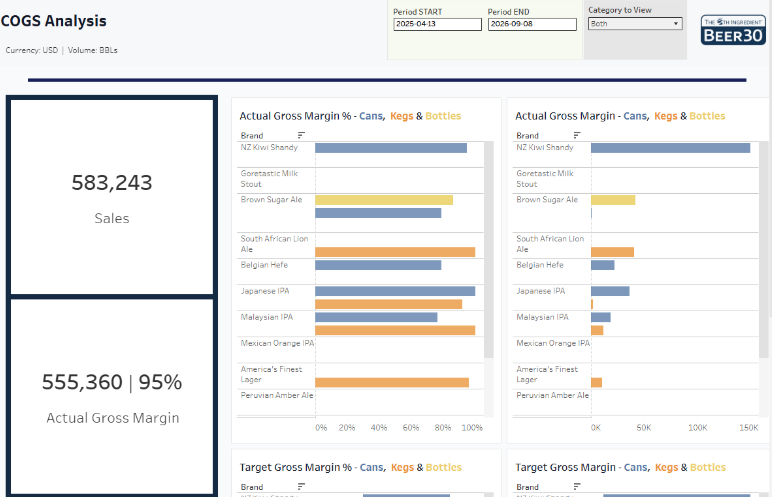
COGS becomes more valuable when it’s connected to operational performance. Review these metrics by brand, batch, packaging format, and reporting period:
Without tracking all of the metrics that can impact your brewery’s margins and success, it’s harder to put knowledge into action. Batch-level and SKU-level analysis makes it easier to locate the specific product, process or package behind a changing margin, and to do something about it.
Many costing problems begin with small gaps in day-to-day data collection. Common mistakes include:
Strong COGS reporting starts with consistent transactions: receive materials, record usage, measure transfers, capture losses, complete packaging runs and reconcile physical inventory.
Spreadsheets can estimate your products’ costs, but they become difficult to maintain as a brewery adds brands, formats, locations, staff, and process complexity. Brewery management software connects inventory movements with the work that created them.
Beer30® helps breweries track raw materials, production, WIP, packaging, and finished goods in one system. Your costs remain connected as beer moves through double and triple batching, transfers, tank splits, blends, and packaging runs, allowing teams to review actual cost by batch, volume, and packaged item.
Beer30 also allows production teams to record brewing data in real time without stopping your brew day because an invoice or inventory receipt hasn’t been entered yet. Your inventory details can be reconciled afterward, while your production team can brew without issue. And best of all? No issues with drifting or inaccurate costs or inventory counts..
With accounting integrations for QuickBooks Online, Xero, NetSuite, and others, Beer30 can also help reduce duplicate entries and align your brewery’s inventory and depletions with your actual finances. The result is a more traceable path from ingredients and production to the brewery's balance sheet and income statement.
Accurate reporting is only useful when it changes decisions. Brewery leaders can use COGS data to:
The best process is one that improves as it evolves: establish a target, capture actual results, investigate meaningful variances, take action, and measure whether the change improved the next batch.
If you have ever added fruit to a beer and dealt with trub buildup, clogged filler heads, or haze in a finished product that was supposed to run clear, The HOPGUILD has something worth knowing about.
The HOPGUILD, Beer30 Marketplace Vendor and one of the craft brewing industry's most trusted ingredient suppliers, has expanded their FRUITGUILD lineup to include clarified fruit concentrates. This is a category of fruit ingredient that is becoming increasingly important not just for craft brewers but for hard seltzer producers, cannabis beverage manufacturers, and anyone running fruit additions through a canning line.
The HOPGUILD published a detailed technical guide covering how clarified fruit works, why it matters at every stage of production, and what the regulatory implications are for canned beverages. It is one of the more thorough breakdowns of this topic written specifically for brewers and beverage producers. You can read the full guide to clarified fruit concentrates here.
The HOPGUILD's clarified lineup currently includes five varieties, all available in bag-in-box, bag-in-drum, and bag-in-tote formats sized for pilot batches through full production runs.
More varieties are being added to the clarified line on an ongoing basis.
Connect with The HOPGUILD through the Beer30 Marketplace for exclusive member pricing and more!
Across the U.S., more breweries are expanding into distilling to diversify revenue and attract new customers. From whiskey and gin to ready-to-drink cocktails, craft beer brands more than ever see spirits as a natural next step. But there’s one big challenge breweries run into right away: shared ingredients.
When you’re juggling the same grains, yeast, barrels, and packaging across beer and spirits, it’s easy for costs to get lost in the shuffle. And if you’re tracking inventory in spreadsheets, you may never know which side of your business is really profitable.
That’s why forward-thinking breweries are turning to brewery management software like Beer30.
On paper, adding distillation to your brewery sounds simple: you already order malt and grain, so just allocate some to whiskey. You’ve already got packaging suppliers, so why not bottle both beer and spirits?
But in practice, things get messy fast:
Without accurate brewery software, costs slip through the cracks, and margins disappear without anyone noticing.
Why Shared Ingredients Can Sink Your Margins
Spirits production ties up more time, tanks, and raw materials than beer alone. If costs aren’t tracked precisely:
The solution? A single source of truth with brewery management software.
Beer30’s Command Center gives breweries a real-time view of their operations. Instead of juggling disconnected spreadsheets, you get one platform to manage it all.
This is where brewery software stops being “nice-to-have” and becomes essential for growth.
When breweries add distilling, shared ingredients like grains, yeast, and packaging make it hard to know your true cost of goods sold (COGS). That’s where Beer30’s brewery software inventory reports come in.
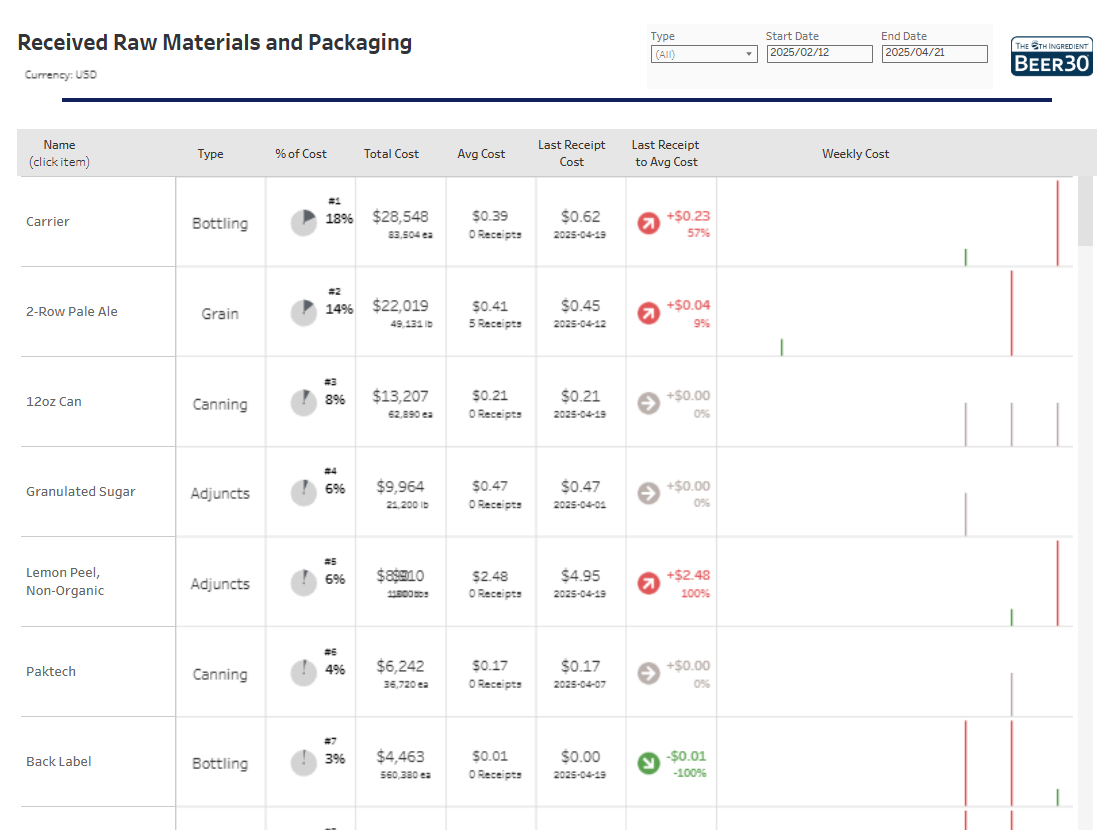
Received Raw Materials & Packaging Report
This report gives you complete visibility into how much you’re spending on every input your beer or spirits need, along with cost changes over time. You’ll catch price fluctuations immediately instead of finding out at the end of the month, giving you the power to respond quickly to protect your margins and accelerate your business.
Raw Materials & Packaging by Brand Report
This view ties ingredient usage directly to each brand, whether it’s beer or spirit. Whether it’s 2-Row Pale Ale going into your IPA or into a whiskey mash, you’ll see exactly where costs are allocated.
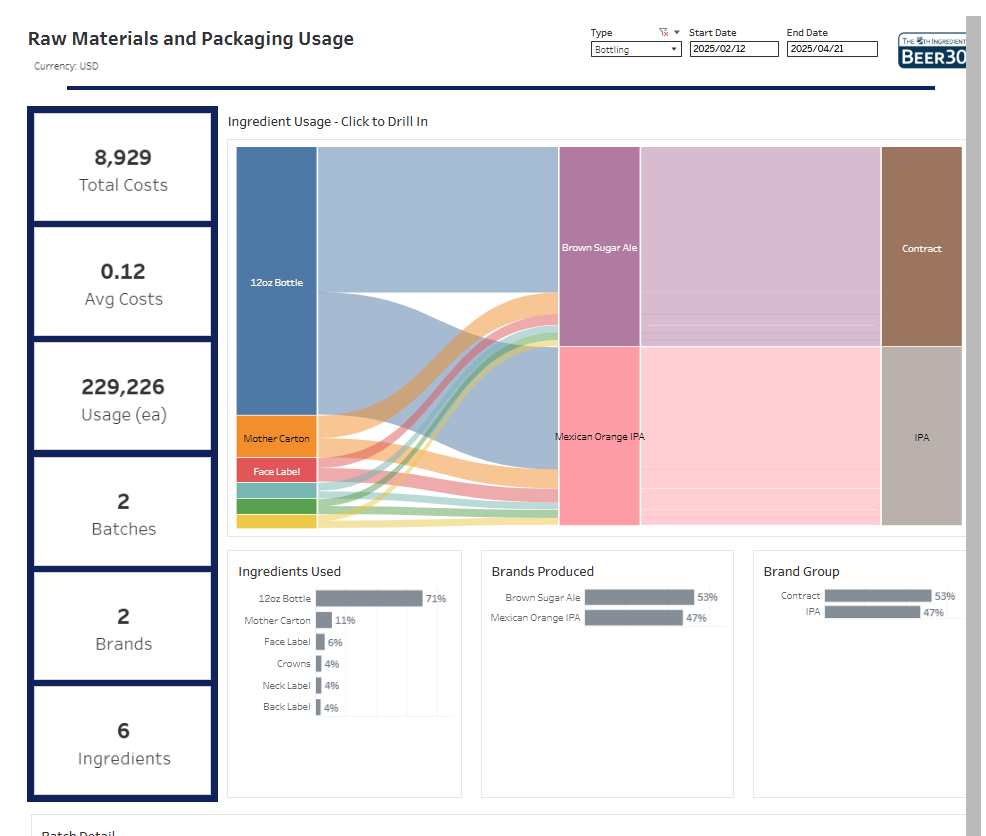
Raw Materials & Packaging Usage Visualization
This advanced report lets you follow the entire flow of ingredients from grains, hops, adjuncts, packaging supplies, and more to see what products they flow into and how important they are to your portfolio of products. You’ll be able to visualize better than ever your supply chain, your dependencies, and what raw materials are most important to secure for the future of your business.
Adding distillation can unlock major growth for breweries, but only if you keep costs under control. Shared ingredients are a hidden trap that can eat away at profitability if you’re not tracking them carefully.
With Beer30’s brewery software, inventory reports, and Command Center, you’ll have the visibility to expand into spirits without losing sight of your beer margins.
Ready to see how the best brewery software can transform your operations? Schedule a demo of Beer30 today.
The next big shift in craft brewing might not come from a hop farm; it could come from a dispensary.
As consumer preferences evolve, breweries are finding themselves at a crossroads: keep doing what’s familiar, or start exploring bold new frontiers like cannabis-infused beverages (cannabev). And while THC- and CBD-based drinks still carry a whiff of novelty, they're gaining traction, fast.
In 2025, brewers across the country are looking beyond the IPA and asking: Is this where the market is going?
If so, how do we navigate legal constraints, make it safe, and make it profitable?
Cannabis beverages, or cannabevs, are no longer a fringe idea. In fact, the market is projected to surpass $2 billion globally in the coming years. Young consumers, especially those seeking a lighter buzz without the alcohol or calories, are showing growing interest in THC- and CBD-infused drinks, and they are increasingly finding a place in their lives and social occasions.
What makes this space so compelling is that breweries already have many of the resources to compete: production facilities, branding experience, cold-chain distribution, and direct-to-consumer channels. But it’s not just a matter of throwing THC into your next seltzer. Entering the cannabev market brings its own unique set of challenges.
Getting into cannabis beverages isn’t like launching a seasonal sour. It requires a strong grasp of regulations, ingredient logistics, and batch-level precision. For breweries relying on spreadsheets or scattered systems, the complexity can quickly spiral.
To succeed, you’ll need to:
Without a centralized brewing software to manage this data, it's easy to lose visibility and confidence.
To produce cannabis beverages with accuracy and compliance, you may need to go beyond spreadsheets. With government regulations keeping tabs on cannabev production, you need a software platform that can adapt to your evolving operations. Beer30 was designed specifically for modern craft beverage producers and is ideal for those entering the THC or CBD beverage market.
With Beer30, breweries can:
Whether you’re brewing beer, hop water, seltzers, or THC-infused drinks, Beer30 gives you the operational foundation and best-in-the-industry reporting to move fast without cutting corners.
With all of the regulations and laws surrounding Cannabis beverages, it may be making your head spin just thinking about it. But don’t worry, we’re here to help.
We’re hosting a free webinar to help answer all of these questions and more!

If you’re thinking about getting into the Cannabev space and want to learn more, check out our free educational webinar: Brewing with Bud – Navigating the Next Big Opportunity in Brewing
Aaron MJ Gore and our panel will go over everything brewers need to get started in the cannabis beverage space without flying blind.
Aaron will be joined by panelists:
Together, they’ll walk through what it actually takes to get into cannabevs, from regulatory concerns to ingredient sourcing, equipment needs, and how brewery software like Beer30 supports it all.
Expect a candid, step-by-step look at:
Join us on July 23rd at 3 PM EST.
Visit the5thingredient.com/cannabev to register today!
This isn't just another product line. It’s an opportunity to diversify your revenue, connect with new customers, and get ahead of a trend that’s not going away.
But entering this space without the right tools is risky. Regulations are strict, ingredients are complex, and margins depend on efficiency. Using a brewery software like Beer30, which can handle multiple product types, provide real-time tracking, and offer compliance visibility, will prepare you to kick off production.
Join us on July 23rd for our free webinar and learn what it takes to build a cannabev program that actually works.
To learn more about Beer30, the brewery software that’s changing the game, book a demo today for a quick chat!
Running a brewery is a balance of art, science, and business. While crafting a great beer is at the heart of it all, long-term success comes down to smart decision-making backed by real, timely data. Like any business, if you’re not making money, you’re not going to last. Two of the most important metrics every brewery should be actively tracking are Sales and COGS (Cost of Goods Sold). When you understand how much you're selling and what it's costing you to make each pint, you unlock the power to optimize your margins, scale smarter, and run a healthier operation overall.
Sales figures are more than just numbers; they tell a story and let you know what’s resonating with your customers at what times of year, where you're growing, and which parts of your business need attention.
By tracking sales broken down by brand and brand type, you can see exactly which beers are driving revenue. This insight helps you prioritize production, dial in your marketing efforts, and make sure your flagship beers are performing as expected. If you analyze performance by format, such as cans, bottles, or kegs, you can understand packaging preferences and align your production accordingly.
If your brewery has sales reps in the market, being able to view their individual performance can help you identify who’s excelling and who might need support. And for those distributing across multiple locations or taprooms, seeing sales data by city or market ensures you’re targeting the right areas and responding to real trends in real time.
It’s a lot of data to take in, but if you manage it correctly, it can tell you exactly what your next move should be.
On the flip side of the equation is your COGS. While sales are incredibly important, even a wildly popular beer can drain your bottom line if it’s not cost-effective to produce.
Tracking actual vs. target COGS allows you to spot problems before they spiral. If a specific brand is consistently over budget because of packaging inefficiencies, ingredient waste, or poor yields, visibility into those numbers allows you to dig into the root causes and correct the course quickly.
Viewing your COGS by time period allows you to recognize seasonal shifts or supply chain changes that may impact your costs. With raw material costs changing more quickly than ever, the sooner you can see changes coming and respond, the more money you’ll be able to bring back into the business to help you continue to thrive.
The Difficulty of Too Much Data
For many breweries, tracking sales and COGS starts with a spreadsheet. And while spreadsheets are flexible and familiar, they come with serious limitations. They’re often manually updated, which increases the chance of errors or outdated numbers. You might be relying on different sheets owned by different team members, with inconsistent formulas or conflicting information. It’s not uncommon for breweries to spend hours compiling reports, only to realize they’ve made a mistake or missed a trend entirely.
Plus, it can feel overwhelming and hard to find real insights with so much data to keep track of. The lack of organization that comes with using spreadsheets can cause owners and managers to get stuck in inaction. After all, if you don’t make a change, it can’t be THAT bad, right?
Well, much like the holy trinity of rock and roll, Rush (and maybe some other guy) told us, “If you choose not to decide, you still have made a choice.” So if you’re overwhelmed by your spreadsheets and frantically wasting time trying to connect the dots a la Charlie Day, then why even collect the data?
You need to be able to decipher your data and make actionable decisions (bonus points if you can do that without wasting hours trying to make sense of it all).

This is where brewery management software like Beer30 shines. Beer30’s Command Center is your centralized hub for brewery insights, designed to put everything you need to know about your Sales and COGS in one place, updated in real time, and easy to use.
On the Sales Dashboard, you can see:
This allows you to assess performance from every angle and act quickly on what the data tells you.

On the COGS side, the Command Center gives you:
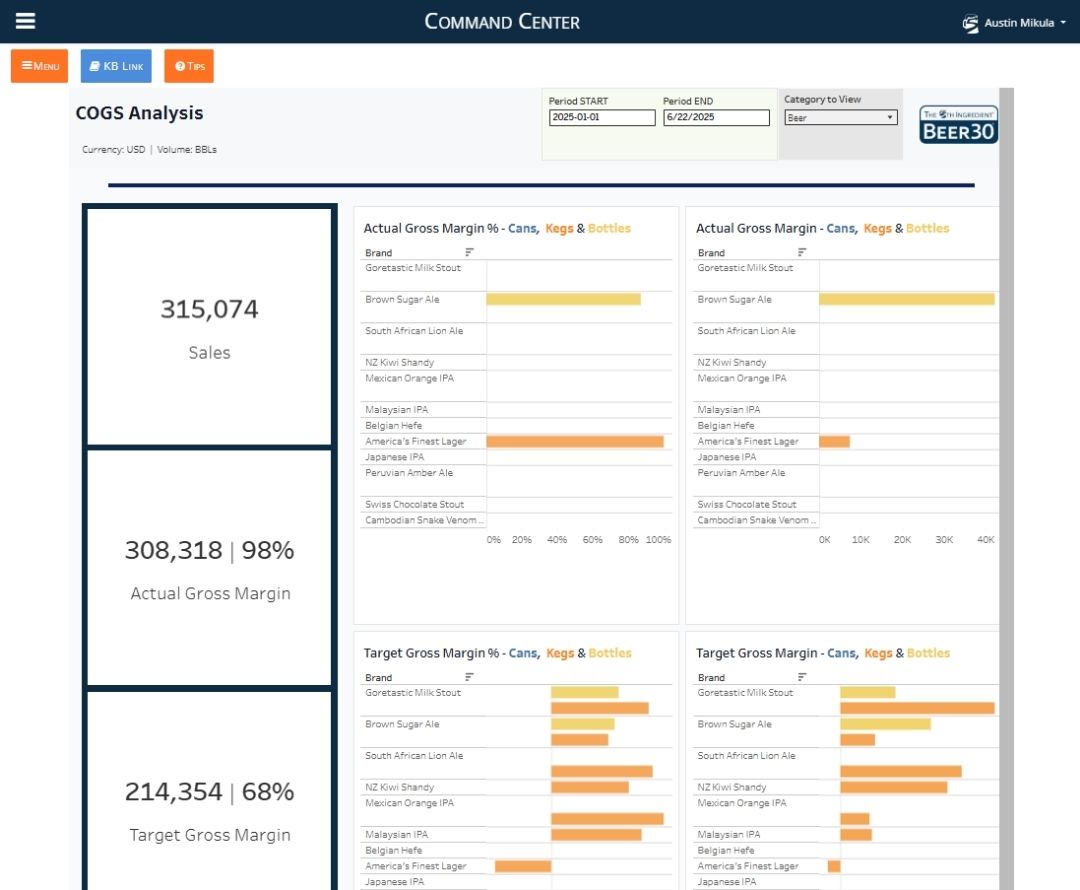
Together, these dashboards remove the guesswork and get you back to actually brewing beer. You’ll know what’s selling, how much it’s costing you, and where you can make small tweaks that drive major results.
At the end of the day, breweries that thrive are the ones that understand their business as deeply as they understand their brewing process. Tracking sales and COGS isn’t just good practice; it’s a competitive advantage that has become a necessity in a challenging market.
With Beer30’s Command Center, it’s never been easier to stay informed and in control.
Explore our Pricing & Features to find the Beer30 package that fits your brewery.
Running a brewery is like juggling chainsaws…if the chainsaws were also on fire. You're managing everything from grain deliveries and fermentation schedules to customer orders and profit margins. It's no wonder more and more brewery owners are saying, "enough with the chaos" and turning to brewery software to help get their operations under control.
But here's the thing: not all brewery software is created equal. So what should you actually be looking for?
Think of brewery software as the nervous system of your operation. It connects everything, from the moment grain hits your mash tun to when that beer lands in a customer's hands. While you can try to manage things with whiteboards, sticky notes, and a prayer, the lack of organization, time spent on labor, and lack of data involved aren’t sustainable for true growth. Brewery software is your solution for an all-in-one tracking system that saves you time and dials in your efficiency.
A solid brewery software platform doesn't just track stuff (though it does that really well). It actually helps you make better decisions by giving you real data instead of educated guesses.
Instead of wondering if you have enough pale malt for next week's batch or trying to remember which tank needs cleaning, your brewery software just tells you. It sends alerts when inventory runs low, tracks every batch from start to finish, and even calculates exactly how much each beer costs you to make.
Good brewery software should include:
When all these pieces work together, something magical happens. You stop fighting fires and start actually running your brewery.
Beer30 was founded by Pulkit K. Agrawal, who worked as a process engineer at Ballast Point. Since then, The 5th Ingredient has built a team of knowledgeable industry veterans. As we grow as a company, one of our main focuses is to bring on team members with a passion for brewing and the brewing process.
This brewery experience and passion for the industry is what sets Beer30 apart. Our team has created Beer30 to be proactive by design. Instead of just storing information, it actively helps you improve your brewing process with every single batch.
Here's what brewers are doing with Beer30:
It's like having a really smart brewing assistant that never sleeps and never forgets anything.
Beer30 recently launched the Command Center with their Cascade update. Think NASA mission control, but for beer.
This interactive dashboard gives you a complete view of your entire operation the moment you log in. No more clicking through a dozen different screens or hunting through reports to figure out what's happening right now. Want more detail on a specific data set? Just click into it.
The Command Center shows you:
Having all this information in one place means you can make decisions quickly and confidently, instead of second-guessing yourself or scrambling to find data.
Choosing brewery software shouldn't feel like solving a puzzle blindfolded. That's why we've created a detailed comparison showing how Beer30 measures against other brewery software options in the market.
Check out our complete Pricing and Features Comparison.
The right brewery software doesn't just help you manage your current operation, it helps take your operations to the next level and streamline your processes so you can focus on brewing beer. Tracking, analyzing, and optimizing everything in real-time, lets you worry less about survival and gives you more time to focus on growth.
Beer30, is leading the charge for craft breweries that want to scale up without losing their minds. Whether you're brewing your first commercial batch or expanding into new markets, having solid brewery software in your corner makes all the difference.
Ready to see what your brewery could look like with the right tools?
Book a demo with the Beer30 team today
Effective brewery management is essential for growth and sustainability in the competitive brewing world. The right management strategies can make a significant difference as breweries strive to stand out in a crowded market. This blog explores a number of approaches that can help breweries streamline operations, enhance productivity, and drive growth.
One of the most impactful ways to enhance brewery management is by embracing technology and automation. Modern brewing software, like Beer30 from The 5th Ingredient, can revolutionize how breweries track their production, manage inventory, and analyze data. This software provides real-time insights into various aspects of the brewing process, enabling managers to make informed decisions quickly.
Lean manufacturing principles, which focus on minimizing waste and maximizing productivity, can be highly effective in management. Breweries can streamline processes and reduce costs by identifying and eliminating non-value-added activities. Key lean principles include:
Implementing lean principles requires a cultural shift and commitment from all levels of the organization, but the benefits in efficiency and cost savings can be substantial.
Sustainability is becoming important in brewing for ethical reasons, cost savings, and brand reputation. Sustainable brewery management practices can include:
Breweries focusing on sustainability can reduce their environmental impact, lower operating costs, and appeal to environmentally conscious consumers.
A motivated workforce is crucial for effective brewery management. Key areas of focus for training can include:
Additionally, creating career development and advancement opportunities can help retain talented employees and build a strong, committed team.
Data analytics is a powerful tool for brewery management. Brewers can gain valuable insights into production efficiency, quality control, and market trends by collecting and analyzing data from various aspects of the brewing process. Areas where data analytics can be applied include:
A robust data collection system like Beer30 allows you to interpret and act on the insights gained.
Strong relationships with suppliers ensure a reliable supply of high-quality ingredients and materials. Developing long-term partnerships with key suppliers can provide several benefits, including:
Collaboration with suppliers can help breweries manage supply chain risks and stay ahead of market trends.
Breweries can use various methods to connect with customers, including:
Breweries can improve their products and enhance customer satisfaction by actively seeking and acting on customer feedback.
In a constantly changing market, breweries may remain competitive and draw in new business by broadening their range of products. This can involve:
Diversifying product offerings increases revenue potential and enhances the brewery's brand image and market presence.
Optimizing distribution channels is crucial for reaching a wider audience and increasing sales. Strategies for improving distribution include:
Efficient distribution management ensures that products reach customers quickly and in optimal condition, enhancing customer satisfaction and loyalty.
Key practices of financial management include:
Breweries can ensure long-term sustainability and growth by focusing on financial management.
Effective brewery management requires a combination of innovative strategies, technology, and a commitment to continuous improvement. By embracing these top 10 strategies, breweries can optimize their operations, enhance product quality, and drive growth in a competitive market.
Implementing modern brewing software like Beer30 by The 5th Ingredient can provide the necessary tools to achieve these goals. With a focus on efficiency and quality assurance, breweries can build a strong foundation for success.
As the demand for non-alcoholic options continues to rise, many brewers may be wondering if venturing into the market of N/A beer is the right choice for your brewery.
Before you decide, it’s important to understand what goes into brewing N/A beer, if it’s worth it, and what the alternatives are to brewing non-alcoholic beer.
Non-alcoholic beer (NA beer) typically contains less than 0.5% alcohol by volume (ABV). The goal is to create a beverage that mimics the taste, aroma, and everything we love about traditional beer while containing minimal alcohol.
Seems pretty straightforward right? Well, unfortunately, when you really get down to the process involved with producing, serving, and retailing N/A beer, the difficulties start adding up, making the whole process a bit more hazy (pun intended).
Before you start brewing non-alcoholic beer, it’s good to know some of the common issues that come with it. Many breweries that brew N/A beer have had to overcome issues with packaging, dirty lines, and freezing.
Packaging: Packaging N/A beer comes with a lot of issues since the alcohol in beer is a big factor in reducing the food safety risk. To avoid running into food safety issues with N/A beer, it’s important to pasteurize it thoroughly. As one Reddit user says, “Pasteurize the fuck out of it.” Not only will the pasteurization help with food safety issues but will also help make sure the ABV doesn’t go up after packaging during a second fermentation.
Dirty Lines: If you plan on serving your N/A beer on tap, you’ll need to make sure that you consistently clean your lines. This means cleaning them pretty much every day. Similarly to how alcohol prevents safety issues in packaged beer, the alcohol being served on tap helps keep your lines safe. Without alcohol, the high sugar content of beer makes it a breeding ground for pathogens. This can be extremely dangerous if not properly cleaned daily.
Freezing: For those breweries that are in colder climates, freezing can also be an issue. Without the higher alcohol content, the freezing temperature of N/A beer is much higher, making it easier for it to freeze in the colder months. Freezing beer can damage both kegs and lines in your brewery and ultimately be a pain in the ass to empty the tank.

Alternatives to brewing N/A beer
With all of that in mind, there are some ways around brewing N/A beer at your brewery that could help you avoid some of the pitfalls. If you still want to offer a delicious non-alcoholic option at your brewery, you can make hop water, N/A Seltzer, or you can buy N/A beer from a different brewer and offer it at your brewery.
Making Hop water: Hop water is a great alternative to brewing N/A beer since it’s non-alcoholic from the start. It’s basically just a combination of hops, water, and citric acid to bring the ph level down. There’s no barley or malt (although either of these can be added) so the flavor is quite different and the process for making it is much easier. We won’t go into all of the details of how to make hop water at your brewery in this blog (maybe a blog for a different day), but you can learn how to add hop water to your lineup
Making N/A Seltzer: Similar to making hop water, making non-alcoholic seltzer is a great way to offer a N/A option without the need to brew N/A beer. Check out our blog post on brewing techniques for seltzers to learn more about that process.
Outsourcing N/A: If you’re looking for an easier option than making hop water, but still want to offer something non-alcoholic besides water, you can stock your taproom with N/A beer from other breweries. I know this may sound like it goes against everything a brewery stands for. After all, why did you start a brewery if you’re just going to get beer from somewhere else? Well, sure, but as we mentioned, brewing N/A beer is a pain in the ass.
Not only that, but it’s good for breweries to collaborate. Partnering with a brewery that does N/A beer really well is nothing to be ashamed of! Not only are you supporting other brewers in the space, but you’re saving yourself time and money by doing so.

Now, all that being said. If you still want to make Non-alcoholic beer at your brewery there are a few different techniques that you can take.
Process: This technique involves controlling the fermentation process to limit alcohol production. It can be achieved in a few different ways:
-Using special yeast strains that produce less alcohol during fermentation.
-Fermenting at lower temperatures to slow down yeast activity and alcohol production.
-Halting the fermentation process early by cooling the beer, filtering out the yeast, or pasteurizing the beer.
Pros:
Flavor and Aroma Retention: This method tends to preserve much of the original flavor and aroma of the beer because the basic brewing process is similar to regular beer production.
Less Processing Required: Since the beer doesn't need to undergo further alcohol removal, the process is relatively straightforward.
Cons:
Consistency Challenges: It can be difficult to achieve consistent results, as even slight variations in the fermentation process can affect the final product, although brewery software like Beer30 can help with fermentation monitoring (among many other things).
Limited Alcohol Reduction: This method may not reduce alcohol content as effectively as other methods, often resulting in beers with lower but not zero alcohol content.
Process: Vacuum distillation involves removing alcohol from fully fermented beer by heating it under reduced pressure. This lowers the boiling point of alcohol, allowing it to evaporate at a lower temperature, thus preserving more of the beer's original flavor compounds.
Pros:
Flavor Preservation: Since the beer is heated to a lower temperature, more of the original flavor and aroma compounds are retained compared to traditional distillation.
Effective Alcohol Removal: This method can effectively reduce the alcohol content to very low levels.
Cons:
Specialized Equipment: Requires vacuum distillation equipment, which can be costly and complex to operate.
Energy Intensive: The process can be energy-intensive, adding to production costs.
Process: This method uses a filtration system to separate alcohol and water from the beer. The beer is forced through a membrane that allows water and alcohol to pass but retains the larger flavor and aroma molecules. The alcohol is then removed from the separated liquid, and the remaining liquid is recombined with the flavor-rich concentrate to create non-alcoholic beer.
Pros:
High-Quality Results: Can produce non-alcoholic beer with excellent flavor retention, as most of the original flavor compounds remain intact.
Precision: Allows for precise control over the final alcohol content.
Cons:
Expensive: The technology and equipment required for reverse osmosis are costly.
Complex Process: The process is sophisticated and requires careful management to ensure quality.
Process: This method involves brewing a high-gravity beer, which has a higher concentration of alcohol and other components, and then diluting it with water to reach the desired alcohol content.
Pros:
Simplicity: The process is straightforward and doesn't require specialized equipment.
Cost-Effective: Less expensive than other methods since it relies on standard brewing practices and readily available water.
Cons:
Flavor Dilution: The resulting beer can have a diluted flavor profile if not done carefully, potentially compromising the beer's taste and mouthfeel.
Balance Issues: Maintaining the right balance of flavor and body can be challenging, requiring precise calculations and adjustments.
Each of these methods has its own set of advantages and challenges, making the choice of method dependent on the specific goals, resources, and expertise of the brewer.
Managing the intricate process of brewing N/A beer becomes much more efficient with the right brewery software. Here’s how it can help at every stage of production:
Brewery software allows brewers to track and tweak recipes for N/A beer, ensuring consistent flavors and aromas with every batch.
Monitoring key brewing parameters—such as fermentation temperature, mash time, and alcohol content—is simplified with brewery software. It ensures that brewers can consistently replicate their best batches.
From pH levels to filtration data, brewery software ensures quality control is never compromised. By tracking every step of production, brewers can quickly identify and address any deviations from desired standards.
Never worry about running out of raw materials or packaging supplies mid-production. Brewery software tracks your inventory levels and alerts you when supplies are running low, helping avoid costly production delays.
Once your N/A beer is ready for market, brewery software helps manage your finished goods inventory and handles sales orders, packing slips, and picklists, ensuring smooth distribution to customers.
Brewery software simplifies the process of meeting industry regulations. It helps track every batch’s production history, ensuring compliance with alcohol content limits, food safety, and labeling requirements.
Brewing non-alcoholic beer comes with its challenges, but with the right techniques and brewery software, it can be a rewarding endeavor. Whether you decide to brew N/A beer, explore alternatives like hop water, or outsource production, the decision depends on your brewery’s goals and capabilities.
By leveraging brewery management software like Beer30, brewers can streamline their processes, ensuring efficiency, consistency, and high-quality results in every batch of non-alcoholic beer.
If you’re interested in leveraging Beer30 software, to keep track of everything from recipe management to distribution and compliance, please reach out to book a demo or get a pricing quote.
Are you looking for effective brewery software to streamline your operations? Beer30 Brewery Software has officially integrated with Square POS, offering breweries real-time syncing of their inventory and sales. This powerful integration is designed to simplify your brewery's inventory management, reduce errors, and save time.
To find out how you can seamlessly integrate Beer30 with your Square POS at your brewery, simply email us at pint@the5thingredient.com or book a demo today!
Managing your brewery’s inventory has never been easier. With Beer30 Brewery Software and Square POS, your taproom and wholesale inventory are synced in real time. No more manual updates or delays in getting an accurate picture of your stock levels. This real-time sync ensures that your brewery inventory software always reflects current levels, helping you avoid costly mistakes and inventory discrepancies.

Beer30’s Accounting Sync module combined with Square POS allows you to track the cost of goods sold (COGS). This functionality gives you financial insights and inventory reports by mapping POS data against Beer30 sales order data. The result? Easy-to-compare reports that offer a clearer picture of your taproom’s financial health and inventory movement.

See all taproom inventory levels in real time with Beer30. No need to wait for a daily pull of inventory or to manually sync recent taproom inventory, we keep it updated so you don’t have to.
Whether you're checking your coldbox or your taproom stock, you’ll have full visibility across all areas of your brewery—making Beer30 the best brewery inventory software for eliminating manual processes.

Eliminate the hassle of manual reconciliations and inventory movements. Beer30’s automatic inventory sync feature saves you hours every week, allowing you to focus on brewing beer rather than managing stock. The POS Sales Reports let you quickly review the revenue from wholesale sales orders and POS transactions, giving you a clear understanding of your brewery's performance.

Mistakes happen, but with Beer30’s automated syncing, you reduce the risk of costly errors caused by manual data entry. Whether it's inputting the wrong numbers or dealing with system delays, Beer30 brewery software minimizes human errors by keeping your inventory in sync with your sales.
Beer30’s integration with Square POS makes it the ideal brewery software for Square users. With features like real-time inventory syncing, better financial reporting, and error reduction, this brewery inventory software helps you save time, avoid costly mistakes, and focus on what matters most—brewing great beer.
If you’re interested in learning more about Beer30, reach out to book a demo today, and let’s talk about how Beer30 software can help your brewery thrive.
The Craft Brewer’s Conference (CBC) in Las Vegas is just around the corner and we are beyond excited to see everyone attending the biggest brewing conference in the United States! For us at Beer30 and The 5th Ingredient, we love being able to connect with brewers and see what you’ve been up to.
We hope you’ll be able to stop by our booth #2581 and say hello! We’re going to be bringing back the selfie contest this year AND we’ll be running a scavenger hunt with some of our friends in the industry with some EPIC prizes! Be sure to follow us on social media for the full details.
With CBC coming up, it got us thinking about other awesome events that every brewery should know about.
We put together a short list of upcoming conferences you won’t want to miss for 2024.
Craft Brewer's Conference 2024
Las Vegas, NV | April 21 - 24
Of course, number 1 on our list is the Craft Brewer's Conference in Vegas! It is undeniably one of the most anticipated events in the brewing industry. This year’s event is promising another great experience for brewers and industry professionals.
CBC this year will offer loads of educational seminars to help you keep up to date with what’s going on with everything from mastering the art of barrel aging to exploring innovative sustainability practices, these seminars offer a deep dive into the latest trends and techniques shaping the craft beer industry.
You can expect dynamic sessions led by industry experts, covering topics like yeast management, flavor profiling, and market analysis. No matter what your brewing experience is, these seminars will provide invaluable insights and practical knowledge to help navigate the changing landscape of craft brewing.
While you’re at CBC, check out The World Beer Cup! Known as “the Olympics of beer,” the World Beer Cup is the most prestigious beer competition in the world, held annually in conjunction with the Craft Brewers Conference & BrewExpo America.
The Craft Brewer’s Conference will also be a great place to connect with other brewers, vendors, and suppliers in the industry who can help your brewery expand its reach or streamline operations.
Be sure to stop by the Craft Beer Professionals Welcome to Vegas party sponsored by Beer30 and The 5th Ingredient. This event is a great way to kick off your week in Vegas and to get to know some awesome members of the community.
But CBC is just the start! Check out some of the other noteworthy conferences and events that every brewer should know about below.
Great American Beer Festival (GABF)
Denver, CO | October 10 - 12
The Great American Beer Festival stands as one of the premier events in the craft beer world, drawing brewers from across the nation to Denver, Colorado, each year. Brewers flock to GABF not only for the chance to showcase their brews to a vast audience but also for the unparalleled networking opportunities and industry recognition it offers.
With over 4,000 beers available for tasting, attendees can explore a staggering variety of styles, flavors, and brewing techniques, fostering inspiration and innovation. Plus, GABF hosts educational seminars, workshops, and panel discussions led by industry experts, providing invaluable insights and resources to brewers of all levels.
World Brewing Congress
Minneapolis, MN | August 17-20
The World Brewing Congress is hosted by the American Society of Brewing Chemists, Master Brewers Association of the Americas, Brewery Convention of Japan, European Brewery Convention, and the Institute of Brewing and Distilling to provide a compass for the brewing community to chart its course through the challenges that brewers and brewing professionals encounter on a global scale.
This 4-day event provides workshops, engaging scientific and technical sessions, interactive panel discussions, and memorable networking with fellow peers and experts from over 25 countries around the world.
European Beer Star
Nuremberg Germany | November 27
With over 70 beer style categories representing the rich diversity of European brewing traditions, the European Beer Star competition provides a platform for brewers to demonstrate their mastery of classic styles and innovation within established parameters. For brewers passionate about preserving and celebrating Europe's brewing heritage while pushing the boundaries of quality and creativity, the European Beer Star competition offers a prestigious and highly coveted accolade.
State Guild Events
In addition to these large-scale conferences and competitions, there are also numerous state brewer’s guild events that take place throughout the year! These smaller events are the perfect opportunity for you to get in tune with what’s going on locally and connect with other brewers and suppliers in the same geographic region.
Look up your local state guild and get involved with your community to make impactful changes to the brew scene in your area.
Conclusion
As you can see, 2024 is shaping up to be an exciting year for brewers around the world. With a lineup of conferences and events that promise to educate, inspire, and connect, there's no shortage of opportunities to take your brewing game to the next level. From the legendary Craft Brewer's Conference in Las Vegas to the smaller state guild events, each gathering offers a unique chance to learn, network, and celebrate the craft we all love.
We hope you’ll be able to attend these events and we hope to see you at CBC! Don't forget to swing by booth #2581 to see the Beer30 team and learn how Beer30 software can revolutionize your brewery operations.


