Your canning run is tomorrow, but the can count, inventory forecast, and sales orders aren’t telling the same story. Somewhere in your brewery’s records is the information you need. You just have to find it, and make sense of it before the line starts.
That’s where AI can help.
AI can help breweries analyze inventory, production, quality, and sales data to spot trends, investigate problems, and make more informed decisions. Your team brings the experience and judgment. AI helps you work through the information faster.
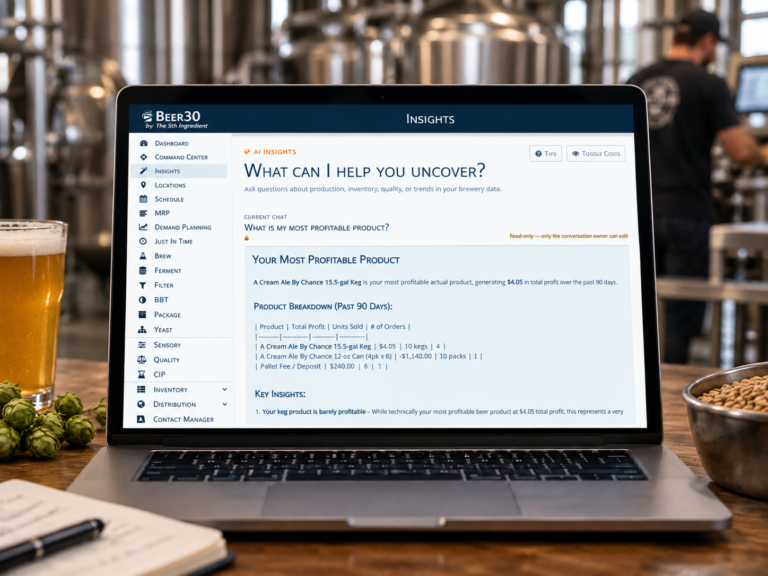
With Beer30® Insights™, you can ask questions about the data your brewery already tracks in Beer30 and get insights and recommendations without needing any coding or setting up separate API or MCP integrations. Here are some practical ways to put that to work.
Think about the questions your team asks every week:
Answering those questions often means opening several reports, comparing records, and piecing together what happened. AI can help connect those details and highlight where to look next.
The more specific your question, the more useful the answer. “How can we improve profitability?” is a big starting point. “Why did COGS per barrel increase for our flagship IPA over the last three months?” gives you something concrete to investigate.
AI can help connect inventory, purchasing, production plans, and costs so your team can see how a change in one area affects the rest of the brewery.
Nobody wants to discover a missing ingredient on brew day, or find out halfway through packaging that there aren’t enough cans.
Try asking:
“Which ingredients or packaging materials could run short next week, based on our brew schedule and expected deliveries?”
That question brings stock levels, upcoming demand, and purchasing into the same conversation. Your team can then confirm delivery dates, check physical counts, and adjust orders before a shortage disrupts the schedule.
Beer30’s material resource planning (MRP )tools already help breweries plan around inventory and upcoming brews. Beer30 Insights adds a way to explore the business impact: What happens to costs if we substitute an ingredient? Which planned batches would a delayed delivery affect?
Brewery Cost of Goods Sold (COGS) measures the costs associated with producing the beer you sell. Ingredient prices, packaging costs, yield, and beer loss can all affect it, and it can be far more variable from batch to batch than more traditional methods such as average costs over time can account for.
When costs climb, you need to know what’s driving the change.
Try asking:
“Which recent batches of our pale ale had the highest COGS per barrel, and what changed compared with similar batches?”
Maybe malt prices increased. Maybe packaging losses were higher. Maybe the batch produced less saleable beer than expected.
Beer30’s batch and package cost reporting gives you the data and information that you need to investigate those differences. AI can help narrow the search so you can decide whether to review a supplier, adjust a process, or revisit pricing. After all, you don’t put revenue in the bank, only profits. Understanding your costs isn’t just key…. it’s critical.
Production planning is a balancing act. Tanks, residency times, staffing, materials, and packaging all need to line up. AI can help your team compare the plan with what’s actually happening.
Try asking:
“Based on recent fermentation timelines, which tanks should be available for next week’s brews?”
That gives your production manager a starting point for planning capacity. Follow up with questions about delayed transfers, cleaning time, or what happens if a batch needs another two days.
The goal is to make scheduling assumptions easier to see and adjust. Your brewer still decides when the beer is ready, and if it’s up to your standards.
Meanwhile, Beer30’s production and scheduling tools bring tank activity, tasks, and batch records together, giving your team context for those decisions.
A batch that falls short of its target volume can hurt margins. But knowing the total loss doesn’t tell you where it happened.
Try asking:
“Across recent batches of this recipe, where is the biggest difference between target and actual volume?”
Then get more specific:
“Are losses higher during transfers or packaging?”
Breaking the question into process steps helps your team focus its investigation. Remember that getting the right answer with an AI brewery advisor like Beer30 Insights means drilling into the answers to get to what’s most important to your decision-making. In that way, it’s not much different than talking to one of your colleagues, and can be just as important. If a pattern points to a particular vessel or packaging run, you can review the equipment, measurements, and process records.
Tools like Beer30’s Command Center dashboards can also help identify where your yields are suffering, so that you can use that information to make the improvements you need to save money on every batch.
Even a small improvement in yield can mean more beer to sell from the same brew. And that means money and labor saved, every single batch.
The beer may be selling well overall while the packaging mix is off. You could be sitting on cans while your customers are asking for kegs.
Try asking:
“Based on recent orders and finished-goods inventory, should we adjust the can-to-keg split for our next IPA packaging run?”
Beer30’s packaging forecasting tools help connect demand with production needs. AI can help you explore changing buying patterns and their implications.
Before changing the run, confirm orders, packaging supplies, and shelf-life considerations. Then revisit the plan as demand changes.
AI can help your team spot patterns in quality across multiple batch records and identify questions worth investigating. That can make it easier to catch a developing issue or understand why a beer is behaving differently. After all, it only takes one diastaticus infection to ruin a whole brewery of fermenting beer, and the sooner you catch it, the less it will cost you.
Try asking:
“Have terminal gravity or pH readings changed across recent batches of this lager at this point in fermentation, and what other recorded variables changed during that period of time?”
A useful comparison needs context. Recipe revisions, ingredient suppliers, sampling times, and measurement practices can all affect the results. Only by identified the common threads in quality issues can you put processes and interventions in place to mitigate them.
If a pattern appears, your team can review batch logs, instrument calibration, and sensory notes. Beer30’s batch traceability and customizable measurement tracking help connect those records to the relevant beer and packaged lots.
A tool such as Beer30’s Gold Standard Fermentation Curves can also provide a live look into how your beer is trending versus prior batches. This lets you get ahead of issues early, when you can still prevent costly dumped batches or compromised quality.
Yeast is the engine by which wort becomes beer, but it is also one of the trickiest and most finicky variables in the brewery. Mastering your yeast, from the first pitch to the last, is essential to making beer that is both high in quality and low in cost.
Try asking:
“Did slower attenuation coincide with a change in yeast generation or pitch history for this beer across the last few batches?”
That can help your brewer identify which batches deserve a closer look and whether yeast handling might be contributing to a change.
Beer30’s yeast genealogy records provide context for comparing lots, generations, and fermentation performance. AI can help surface relationships, while your brewing and quality teams determine what they mean.
Sales data becomes more useful when you can connect it with inventory and production. A growing account is an opportunity, but you need the right beer available to support it, and to know what they are likely to be interested in before you ever walk through the door.
Try asking:
“Which accounts have increased IPA orders over the last three months, and what else do those accounts buy?”
That can help your sales team identify potential cross-selling opportunities and prepare more informed account conversations.
You can also investigate declines:
“Which accounts are ordering less frequently than they used to?”
An order history won’t tell you everything about the relationship, but it can help a rep decide who to contact and what to ask.
Try asking:
“How has this account’s purchasing mix changed between cans and kegs over the last 6 months?”
A shift could reflect seasonality, an event, or changes to the account’s draft program. Bringing that history into a conversation gives your rep a useful starting point, and helps ensure they are connecting the right products to the right customers.
With sales and production records in the same system, your team can also check whether inventory and upcoming packaging runs support a proposed promotion or larger order. Knowing that you’ll have the inventory available for every sales order isn’t just efficient, it’s absolutely critical to making sure you don’t leave money on the table, and customers disappointed.
Start with a decision your team already makes regularly. You don’t need to redesign your business around AI to get value from it.
For example, start with “What sales accounts haven’t order in the last 3 weeks?” Then follow up with “What beers are they most likely to buy, and do we have enough in inventory to ensure we can fulfill those orders?”
You don’t need perfect data, but complete and consistent records make the answers more useful. If information is missing, that’s a good place to improve your tracking, so that you get the best results out the other side.
Your brewery already collects valuable information every day. The challenge is finding time to understand it and use it.
Beer30 Insights helps you ask questions about that information, explore what’s changing, and decide where to focus your attention. From purchasing and tank planning to quality investigations and account conversations, it gives your team another way to put brewery data to work, saving you time, headaches, and money.
Schedule a Beer30 demo to see how brewery management software and integrated AI insights can support your business.
No. AI can help analyze records and identify patterns, but brewing decisions still depend on experience, sensory evaluation, testing, and your team’s judgment. It is a tool, just like your tanks, refractometer, for flow meter. It needs the right person using it to truly make a difference.
You can ask questions about the brewery data tracked in Beer30, including inventory, costs, production, quality measurements, and sales. Specific questions with clear time frames are a useful place to start. If it lives inside of Beer30, it can be a key part of how Insights helps you run your business.
No. You ask questions in plain language inside Beer30, without coding or setting up separate API or MCP integrations. No new licenses, and no headaches.
No, but missing or inconsistent records can limit the analysis. Start with an area where your data is reliable, check the answers, and improve recordkeeping as you go.
AI can support an investigation by highlighting relevant records and trends, or divergences from what you’ve done before. Your team, however, should make testing, release, and compliance decisions based on their own expertise. Remember, AI is a tool, but humans are always at the heart of any brewery.


